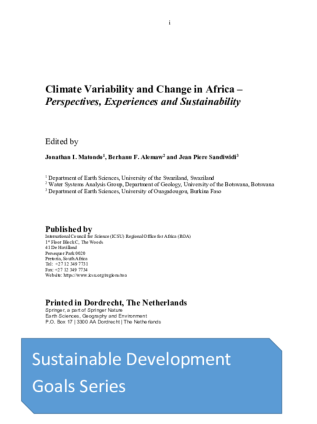
Climate Variability and Change in Africa - Perspectives, Experiences and Sustainability
Type
File
Date of Publication
Jul 01, 2018
Description/Abstract

Sustainability of rain-fed farming systems under climate variability and change conditions is a key concern for policy and adaptation planning processes to improve food and nutrition security. The challenge is to improve farming and tillage practices to enhance soil moisture availability and harvest excess runoff thereby making the farming systems more reliable and resilient to unpredictable risks of climate change and variability. In this short manuscript, an assessment of climate change impact on the agricultural water availability for rainfed systems in southern Africa is discussed through a pilot project conducted recently as part of climate change adaptation integrated modeling of crop-climate-soil systems. We consider the Pandamatenga plains in north-eastern Botswana, which was undertaken with the main indicators of crop yield impact with respect to soil water availability and excess runoff harvesting potential, for the current climatology (1971-2000) and projected over the coming decades up to the 2050s. The indicators of rainfed practices of growing maize, sorghum and sunflower are discussed, which are likely influenced not only by climate, but also the response requiring local and regional adaptation investments for improved food security and increase productivity. The manuscript recommends technical and policy interventions for incorporating climate change adaptation practices, with the view to outscale to national and possibly regional agricultural development planning processes.

Author or Institution as Author
Jonathan I. Matondo
Co-authors

Berhanu F. Alemaw and Jean Piere Sandiwidi

Institution
International Council for Science (ICSU) Regional Office for Africa (ROA)
Language
Category
Resource Type
Citation

Jonathan I. Matondo, Berhanu F. Alemaw and Jean Piere Sandiwidi. International Council for Science (ICSU) Regional Office for Africa (ROA), 2018, Sustainable Development Goals Series, Pretoria, South Africa. 
Climate Change Impacts and Adaptation in Rainfed Farming Systems: A Modelling Framework for Scaling-Out Climate Smart Agriculture in Sub-Saharan Africa

Type
Date of Publication
Aug 01, 2015
Description/Abstract

Improving agricultural water productivity, under rainfed or irrigated conditions, holds significant scope for addressing climate change vulnerability. It also offers adaptation capacity needs as well as water and food security in the southern African region. In this study, evidence for climate change impacts and adaptation strategies in rainfed agricultural systems is explored through modeling predictions of crop yield, soil moisture and excess water for potential harvesting. The study specifically presents the results of climate change impacts under rainfed conditions for ma- ize, sorghum and sunflower using soil-water-crop model simulations, integrated based on daily inputs of rainfall and evapotranspiration disaggregated from GCM scenarios. The research targets a vast farming region dominated by heavy clay soils where rainfed agriculture is a dominant prac- tice. The potential for improving soil water productivity and improved water harvesting have been explored as ways of climate change mitigation and adaptation measures. This can be utilized to explore and design appropriate conservation agriculture and adaptation practices in similar agro-ecological environments, and create opportunities for outscaling for much wider areas. The results of this study can suggest the need for possible policy refinements towards reducing vulne- rability and adaptation to climate change in rainfed farming systems.

Author or Institution as Author
Berhanu F. Alemaw, Timothy Simalenga
Institution
American Journal of Climate Change
Language
Category
Resource Type
Citation

Alemaw, B. and Simalenga, T. (2015) Climate Change Impacts and Adaptation in Rainfed Farming Systems: A Modeling Framework for Scaling-Out Climate Smart Agriculture in Sub-Saharan Africa. American Journal of Climate Change, 4, 313-329. doi: 10.4236/ajcc.2015.44025.

Subscribe to Case Study

Funding Partners