4th Global Foresight4food Systems Workshop Report
This is a report on the 4th Global Foresight4food Systems Workshop Report
CCARDESA(2024) 4th Global Foresight4food Systems Workshop Report
European Union and IFAD
This is a report on the 4th Global Foresight4food Systems Workshop Report
CCARDESA(2024) 4th Global Foresight4food Systems Workshop Report
European Union and IFAD
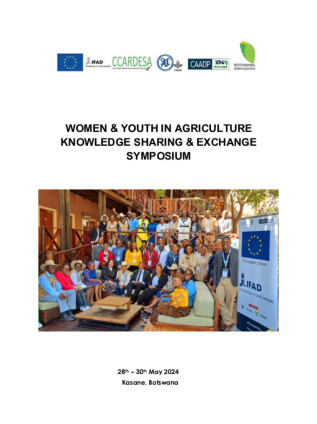
This is a detailed report of the Women & Youth in Agriculture Knowledge Sharing & Exchange Symposium Report
CCARDESA, 2024, Women & Youth in Agriculture Knowledge Sharing & Exchange Symposium Report
CCARDESA Agribusiness and Gender and Youth Responsive Food Systems. AICCRA Conference Proceedings Report.
Mwale N. S., Recha J.W., Kakuwa B., Magagula F., Maapatsane B. 2023. CCARDESA Agribusiness and Gender and Youth Responsive Food Systems. AICCRA Conference Proceedings Report. CCARDESA
Natural Resource Management (NRM) and Trans-frontier Conservation Area (TFCA) development have been a major focus area of cooperation between SADC and Germany for many years. Through the SADC/GIZ Climate Resilience and Natural Resources Management (C-NRM) Programme, the German Federal Ministry of Economic Development and Cooperation (BMZ) promotes the mainstreaming of climate change adaptation and mitigation in trans-boundary protected area management, thereby strengthening the climate change resilience of the local population in and around TFCAs. The SADC/GIZ Climate Resilience and Natural Resource Management (C-NRM) Programme’s main objective is therefore to strengthen cross-border management of natural resources in the SADC region, as a new initiative that builds on the foundation laid by the Adaptation to Climate Change in Rural Areas in Southern Africa (ACCRA) programme. The C-NRM programme continues to build the capacities of SADC member states to integrate climate change aspects into agricultural programmes and investments. The C-NRM project has the following outputs;
The Centre for Coordination of Agricultural Research and Development for Southern Africa (CCARDESA) is a sub-regional organization that was established by SADC Member States (MS) to coordinate agricultural research and development (AR&D) among its 16 Member States. With its headquarters situated in Gaborone, Botswana, CARDESSA‘s vision is to assist member states to attain food security and build a prosperous Southern African region with vibrant rural livelihoods. Its mission is to promote innovative research, technology generation and adoption for sustainable agricultural development through affective partnerships and capacity building.
CCARDESA therefore has a broad mandate to assist its Member States in coordinating their agricultural research and development and also to empower smallholder farmers to improve their product efficiency and generate increased incomes through active market engagement while navigating the current polycrises (Covid-19, worsening climatic conditions, worsening economic growth and the Ukraine war). All of these have negatively affected the global food security.
To mitigate against these negative effects, CCARDESA is supporting smallholder farmers to adopt sustainable agricultural practices, particularly in response to the challenges posed by worsening climatic conditions. However, the main issue is that although CCARDESA has active outputs on areas of KM and information dissemination of their products, there is a serious limitation in audio- visuals as most of their products are in paper format which has been proven not to be as effective. Furthermore, the Internet of Things’ (IoT) main tenet is on digitalization and this is a better way to respond while bridging Africa’s youth demographic dividend.
Insect farming is a high-potential emerging farming enterprise in sub-Saharan Africa and their production has a relatively small ecological footprint. Black Soldier Fly (BSF), Hermetia illucens, is a promising insect species for a sustainable and innovative alternative protein source in animal feed. Little or no evidence exists showing whether BSF is a viable alternative sustainable feed ingredient in aquaculture and animal feed in Malawi or an economically feasible option for farmers. The objective of the study is to evaluate the financial feasibility of BSF farming at various scales of production using Cost-Benefit Analysis (CBA) with data collected from a small-scale pilot BSF farm in Lilongwe. The study addressed the following research questions: (a) What are the costs and benefits of farming BSF in Malawi for (i) small-scale farming (individual farmers, clubs, and cooperatives), and (ii) large-scale commercial farmers? (b) What drives variation in the benefit/cost ratio (BCR) of BSF farming across scales? (c) How could policies improve BCRs of BSF farming to support adoption in Malawi? The indicators used to assess the economic viability of BSF farming for smallholder and commercial farmers in this study included Net Present Value (NPV) and Benefit Cost Ratio. Results imply BSF farming is viable and feasible across scales of production. Small-scale farmers will generate roughly MK507,100 (US$ of gross revenue for one larval cycle and MK2,535,500 (over $2,500) annually. Commercial farmers can generate MK1,536,100 for one larval cycle and MK7,680,750 annually. Sensitivity analysis shows BSF farming remains profitable even within a 10% variation in the cost of production, the price of outputs, and the yield of BSF larvae and frass.
Munthali, G., Chilora, L., Goliath, M., Burke,W.J., Benbow, M.E., Kangʼombe, J., & Safalaoh, A. (2003). The Economic Cost-benefit Analysis of Black Soldier Fly as an Alternative Animal and Fish Feed Ingredient in Malawi. Working Paper No. 23/01. MwAPATA Institute. Published by MwAPATA Institute, Lundu Street, Off Chayamba Road, Area 10/386, P.O. Box 30883, Capital City, Lilongwe 3, Malawi.
The Centre for Coordination of Agricultural Research and Development for Southern Africa (CCARDESA) in collaboration with the Food and Agriculture Organization of the United Nations (FAO), organized a Regional Multi-stakeholder Dialogue event on Vulnerable Farmers’ Access to Fertilizer from 4th to 6th October 2022 in Mbabane, Eswatini.
CCARDESA,2022,Regional Multi-stakeholder Dialogueon Vulnerable Farmers’ Access to Fertilisers: Sharing Good Practices, Innovations and Viable Options.Pg.15, Gaborone-Botswana
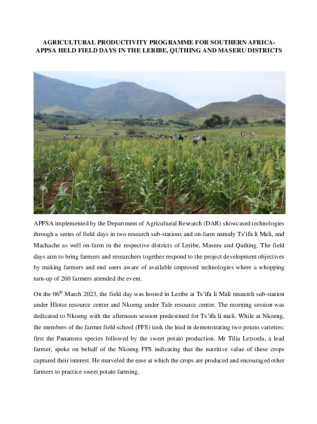
APPSA implemented by the Department of Agricultural Research (DAR) showcased technologies through a series of field days in two research sub-stations and on-farm namely Ts’ifa li Mali, and Machache as well on-farm in the respective districts of Leribe, Maseru and Quthing. The field days aim to bring farmers and researchers together respond to the project development objectives by making farmers and end users aware of available improved technologies where a whopping turn-up of 260 farmers attended the event.
This is a Strategy Report on development of effective partnerships for innovation strategy and action plan
CCARDESA, Strategy Report on development of effective partnerships for innovation strategy and action plan, 2022
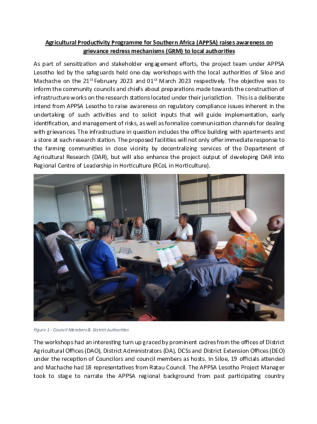
As part of sensitization and stakeholder engagement efforts, the project team under APPSA Lesotho led by the safeguards held one-day workshops with the local authorities of Siloe and Machache on the 21st February 2023 and 01st March 2023 respectively. The objective was to inform the community councils and chiefs about preparations made towards the construction of infrastructure works on the research stations located under their jurisdiction.