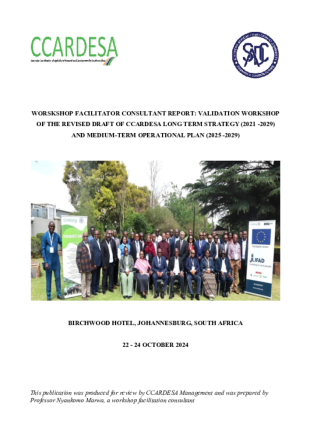
WORSKSHOP FACILITATOR CONSULTANT REPORT: VALIDATION WORKSHOP OF THE REVISED DRAFT OF CCARDESA LONG TERM STRATEGY (2021 -2029) AND MEDIUM-TERM OPERATIONAL PLAN (2025 -2029)

Type
File
Description/Abstract

The Centre for Coordination of Agricultural Research and Development for Southern Africa (CCARDESA) was founded by SADC member states to harmonise the implementation of agricultural research and development (R&D) in the SADC region. CCARDESA intends to address agricultural research and design issues in the SADC region. CCADERSA is executing its mandate through the four main interventions i.e. coordinate, facilitate, promote and improve agricultural technology generation, dissemination and adoption in the region through collective efforts, training and capacity building.

Language
Category
Resource Type

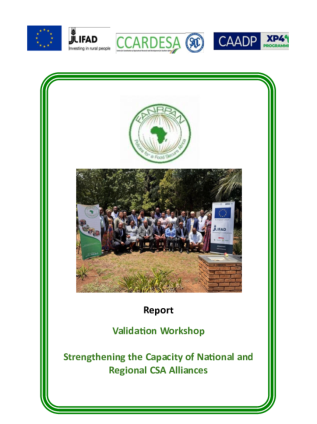
Strengthening the Capacity of National and Regional CSA Alliances

Type
File
Description/Abstract

Agriculture plays a vital role in producing food and ecosystem services in the East and Southern African (ESA) region and is central to fostering regional economic growth, reducing poverty, and improving food security. Agriculture contributes between 4% and 27% of GDP and approximately 13% of overall export earnings, with about 70% of the region's population depending on agriculture for food, income, and employment. However, the region is facing numerous challenges from slow agricultural transformation, growing populations and increasing demand for food, urbanization, and climate change.

Language
Category
Resource Type

2024 CAADP-XP4 Joint Portfolio Review and Planning Meeting

Type
File
Description/Abstract

The 2024 CAADP-XP4 Joint Portfolio Review and Planning Meeting, organized by CORAF and held in Saly, Senegal, brought together key stakeholders to assess the progress of the CAADP-XP4 program and to strategically plan for the final year of implementation. Representatives from AFAAS, FARA, CORAF, ASARECA, and CCARDESA gathered to review milestones, identify pending tasks, and discuss new emerging priorities. The focus was on sustainability, agroecology, digitalization, and ensuring that the CAADP-XP4 program’s legacy continues post-closure. This report provides a detailed review of the discussions, key decisions, and agreements made during the meeting, with a strong emphasis on the strategic rationale for requesting a one-year no-cost extension

Language
Category
Resource Type

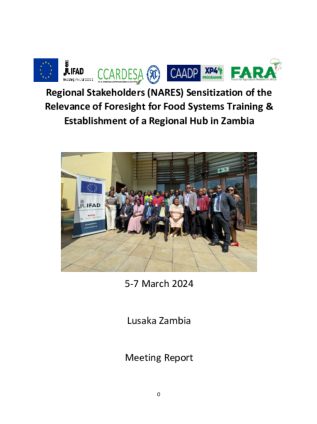
Regional Stakeholders (NARES) Sensitization of the Relevance of Foresight for Food Systems Training & Establishment of a Regional Hub in Zambia

Type
File
Description/Abstract

Food Systems provide a direct pathway to Sustainable Development Goals (SDG) achievement in particular in regard to food insecurity and poverty. Therefore, transforming Food Systems – making them more productive, competitive and resilient is key. At the same time, Food Systems resilience is threatened by conflicts, climate change, inflation (rising food, fertilizer, fuel prices) and also pandemics e.g. Covid 19.

Language
Category
Resource Type

Strengthening of CSA Alliances in the SADC Region

Type
File
Description/Abstract

The Centre for Coordination of Agricultural Research and Development for Southern Africa (CCARDESA) is implementing a regional component of the European Union-funded ‘CAADP ex-Pillar 4 (X-P4) Programme in Southern Africa’ to support national agricultural knowledge and innovation systems (NAKIS) in African countries, benefiting smallholder farmers, youth, women, pastoralists, and marginalized communities.

Language
Category
Resource Type

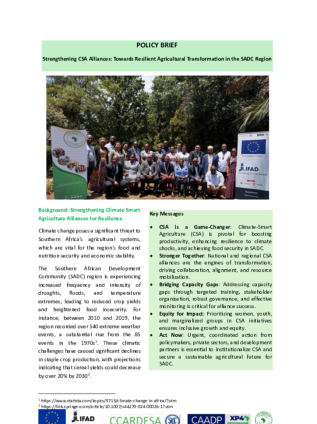
Strengthening CSA Alliances: Towards Resilient Agricultural Transformation in the SADC Region

Type
File
Description/Abstract


Climate change poses a significant threat to Southern Africa's agricultural systems, which are vital for the region's food and nutrition security and economic stability.

Language
Category
Resource Type

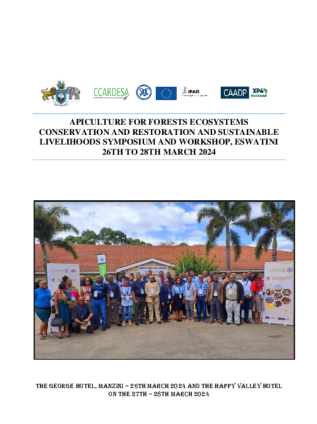
APICULTURE FOR FORESTS ECOSYSTEMS CONSERVATION AND RESTORATION AND SUSTAINABLE LIVELIHOODS SYMPOSIUM AND WORKSHOP, ESWATINI

Type
File
Date of Publication
Mar 26, 2024
Description/Abstract

The Government of Eswatini was offered support by CCARDESA to hold a Symposium on Apiculture for Forests Ecosystems Conservation and Restoration and Sustainable Livelihoods on the 26th March 2024 at the George Hotel, in Manzini. The symposium was followed by a two (2) days workshop for the apiculture technicians from the Ministry of Agriculture, Ministry of Tourism and Ministry of Natural Resources. The beekeeping interim committee which comprises of experienced beekeepers and honey processors were the resource persons in the workshop who also represented the views of the farmers. The workshop was held on the 27th to the 28th March 2024 at the Happy Valley Hotel in Ezulwini.

Language
Category
Resource Type

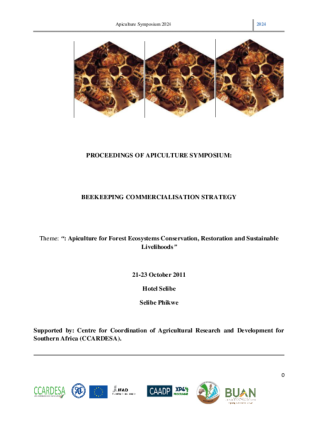
PROCEEDINGS OF APICULTURE SYMPOSIUM: BEEKEEPING COMMERCIALISATION STRATEGY

Type
File
Date of Publication
Oct 21, 2011
Description/Abstract

The first Apiculture Symposium supported by CCARDESA convened at Hotel Selibe in Selibe Phikwe on the 21st to 23rd May 2024. About 100 participants from government departments, Non-Governmental Organisations, Trusts, Farmers (Beekeepers, Forestry, horticulture and arable), suppliers of beekeeping equipment, academia (Botswana University of Agriculture and Natural Resources), Dikgosi, District Commissioner, Deputy Mayor of Selibe Phikwe town, FAO representatives, SPEDU, APIMONDIA and representative from SADC region; Zambia, Zimbabwe, Tanzania, Lesotho, South Africa and Eswatini attended.

Language
Category
Resource Type

Demand of Imported Rice in Mozambique (2011 - 2020)

Type
File
Date of Publication
May 10, 2024
Description/Abstract

Rice plays an important role in the food and nutrition security of the Mozambican population and has been importing rice to meet growing consumption needs. There are several studies regarding demand of imported rice worldwide. However, it is noted that despite the importance of imported rice in national consumption, the empirical and quantitative studies on the demand for imported rice in Mozambique are scarce. This study results from the need to contribute to filling the information gap by providing the quantification of the impact of income and price on the consumption of imported rice. Based on monthly rice import data from 2011 to 2020, obtained from INE, the Source Differentiated Almost Ideal Demand System (SDAIDS) model and the Seemingly Unrelated Rules (SUR) approach are applied to estimate demand systems for imported rice. The period was chosen due to availability of data. The results of this study show that the national production of rice still does not cover internal needs, so the country resorts to imports to fill the deficit. The elasticities of demand for rice imported into Mozambique show that all income elasticities of demand are statistically significant, except for “other countries” or Rest of the World. The results also show that when income increases by 1%, the demand for rice increases by 1.2% when coming from “Pakistan”, and by 1.1% when coming from “Singapore”, by 1.03% for “Vietnam”; and in for those from “Myanmar” (1.1%), which suggests that rice from these countries can be classified in the luxury goods category. The results also illustrate that when the price increases by 1%, the quantities demanded decrease, on average, by 1.06% for rice coming from “Pakistan”; by 1.06% for those from “Singapore”; 1.22% for those from “Myanmar”; 0.96% for those from “Vietnam”; by 0.89% for “India”; by 0.79% for “China”; in 0.974% for “Thailand” and in 0.56% for those coming from “other countries”. The low levels of production and productivity show that it is still a challenge to guarantee rice self-sufficiency in Mozambique, and efforts to improve supply must continue, since the country's dependence on imported rice can potentially create conditions of vulnerability and insecurity and adverse market effects have competitive advantages.

Author or Institution as Author
Macia, S.
Co-authors

Macuácua, J., Vilanculos, A., Mahaluça, F.

Language
Topic
Category
Contact Information
Subscribe to Document

Funding Partners