APPSA Round up - January 2020
Analysis identifyed sewveral yield gaps that could be narrowed with additional investmentments in technology adaptation and dissemination.
Strengthening RCoLs has continued for the past six years covering the upgrading of research infrastructure including farm, laboratory, office equipment, IT and knowledge management sustems.
WAMPP is national in scope covering all of 10 Lesotho’s administrative districts, with a focus on the rangelands that cover more than two thirds of the country’s surface. The project pays special attention to poor rural women and young people with more emphasis on the foothills because there are more incidences of food insecurity.
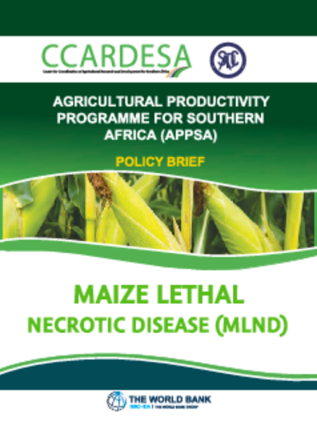
Maize is a major staple food for millions of households in Sub-Saharan Africa. The emergence and prevalence of Maize Lethal Necrosis Disease (MLND) in endemic countries in east Africa among others, threathens the food security and commercial seed trade in the Siouthern African Region.
According to the 2017 Nutrition in WHO African Region report, the prevalence of malnutrition in Malawi, Mozambique and Zambia is very high, and this has been attributed in part to limited dietary diversity. Biofortification represents the most cost effective and sustainable intervention to address micronutrient deficiency malnutrition in Malawi, Mozambique and Zambia compared to commercial fortification and nutrient supplements.
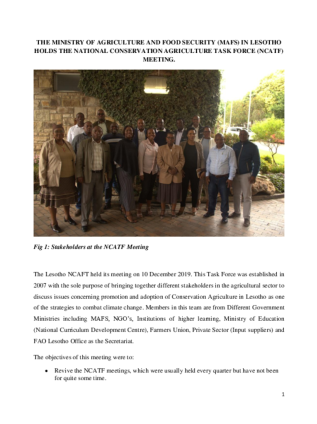
This article is about a meeting that was converned for the Lesotho National Conservation Agriculture Task Force. It was a revival meeting that was last held about two years ago. The importance of such a meeting is to bring stakeholders in the agricultural sector in Lesotho to deliberate on the issues of Conservation Agriculture and how it can be supported and strenghened in order to address this "monster" called climate change.
Conservation Agriculture (CA) is currently widely recognized as a viable approach for sustainable agriculture due to its potentially comprehensive benefits of economic, environmental, and social sustainability. In response to the aforesaid, Tanzania Agriculture Research Institute (TARI) at Uyole Centre initiated intensive research on CA technology practices since 1999. The research started on-station and widened the geographical coverage of CA trials and promotions on-farm from two to 18 villages (Mkomwa et al., 2007) in Southern highlands of Tanzania. An onstation study was undertaken to evaluate influence of CA planting methods on labour, weed and maize yields. The study results show that use of tractor ripper, ox-direct seeder and ox-ripper had high yields of 8.5, 8.5 and 7.6 t/ha respectively compared to hand hoe (4.7 t/ha).
Mwakimbwala R1, Ngailo J1, Mlengera N1, Nyenza E2, Kabungo C 1, Mwalukasa E 2, Urio P 1, Kulwa B1 and Mwabenga (2018). Effect of Conservation Agriculture Planting Methods on Increasing Yield of
Maize: The Case of Southern Highlands Tanzania. 2ACCA Book of Condensed Papers - Final Draft 04.10.2018. https://africacacongress.org/generaldownloads/2acca-book-of-condensed-p…;
Agronomy research
Sondayi, L. (2019). Agromy Research
Pesticides registration in Zimbabwe
Sondayi, L. (2019). Pesticides registration
Cotton varieties in Zimbabwe.