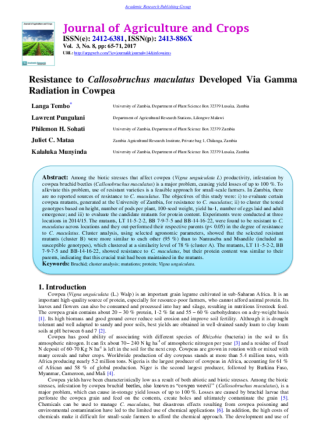
Resistance to Callosobruchus maculatus Developed Via Gamma Radiation in Cowpea

Type
File
Date of Publication
Jan 01, 2017
Description/Abstract

Among the biotic stresses that affect cowpea (Vigna unguiculata L) productivity, infestation by cowpea bruchid beetles (Callosobruchus maculatus) is a major problem, causing yield losses of up to 100 %. To alleviate this problem, use of resistant varieties is a feasible approach for small-scale farmers. In Zambia, there are no reported sources of resistance to C. maculatus. The objectives of this study were: i) to evaluate certain cowpea mutants, generated at the University of Zambia, for resistance to C. maculatus; ii) to cluster the tested genotypes based on height, number of pods per plant, 100-seed weight, yield ha-1, number of eggs laid and adult emergence; and iii) to evaluate the candidate mutants for protein content. Experiments were conducted at three locations in 2014/15. The mutants, LT 11-5-2-2, BB 7-9-7-5 and BB-14-16-22, were found to be resistant to C. maculatus across locations and they out-performed their respective parents (p< 0.05) in the degree of resistance to C. maculatus. Cluster analysis, using selected agronomic parameters, showed that the selected resistant mutants (cluster B) were more similar to each other (95 %) than to Namuseba and Msandile (included as susceptible genotypes), which clustered at a similarity level of 78 % (cluster A). The mutants, LT 11-5-2-2, BB 7-9-7-5 and BB-14-16-22, showed resistance to C. maculatus, but their protein content was similar to their parents, indicating that this crucial trait had been maintained in the mutants. 

Author or Institution as Author
Langa Tembo, UNZA
Co-authors

Langa Tembo* University of Zambia, Department of Plant Science Box 32379 Lusaka, Zambia 
 Lawrent Pungulani         Department of Agricultural Research Stations, Lilongwe Malawi 
 Philemon H. Sohati        University of Zambia, Department of Plant Science Box 32379 Zambia 
 Juliet C. Mataa                Zambia Agricultural Research Institute, Private bag 1, Chilanga, Zambia   
 Kalaluka Munyinda        University of Zambia, Department of Plant Science Box 32379 Lusaka, Zambia 

Institution
Journal of Agriculture and Crops
Language
Category
Resource Type
Citation

Langa, L., Pungulani, L., Sohati, P., Mataa, J., & Munyinda, L. (2017) Resistance to Callosobruchus maculatus Developed Via Gamma Radiation in Cowpea. Journal of Agriculture and Crop [online] vol 3(8), pp 65-71. Available at: : http://arpgweb.com/?ic=journal&journal=14&info=aims&nbsp;

Evaluation of Cowpea (Vigna unguiculata L.walp) Genotypes for Biological Nitrogen Fixation in Maize-cowpea Crop Rotation

Type
File
Date of Publication
Nov 01, 2018
Description/Abstract

Nitrogen is a major plant nutrient which is most limiting in the soil due to soil losses of mineral nitrogen (N) form. To ensure availability of nitrogen in the soil, the study was conducted to screen four cowpea genotypes for Biological Nitrogen Fixation (BNF) and their contribution to maize yield in maize- cowpea rotation. The cowpea genotypes used were mutants LT11-3-3-12 (LT) and BB14-16-2-2 (BB) and their parental varieties Lutembwe (LTPRT) and Bubebe (BBPRT) respectively. Trials were established at two sites (Chisamba and Batoka) of different soil types. The Randomized Complete Block Design (RCBD) with three replications was used. Labelled 15N urea was applied at 20kgNha-1 on the four cowpea genotypes during 2015/16 growing season. Cowpea plant parts were dried and milled for 15N isotopic analysis. The data collected included Nitrogen content and atom % 15N excess in the fixing cowpea genotypes and non-nitrogen fixing pearl millet to determine total nitrogen derived from the atmosphere (TNdfa) and total nitrogen (TN) in plant parts which were further used to compute Biological Nitrogen Fixation (BNF). The results showed that BNF by cowpea genotypes at Chisamba was 63.9 kg ha-1 and was significantly (P<0.001) more than BNF of 6.6 kgha-1 at Batoka. The LT mutant fixed significantly (P<0.001) higher nitrogen of 86.1 kgha-1 and 16.5kg ha-1 at Chisamba and Batoka respectively than other genotypes. However, both BB and LT mutants significantly fixed more nitrogen than their parents and have demonstrated to increase maize grain yields up-to 12 tha-1 in the maize – cowpea rotation. 

Author or Institution as Author
Simunji Simunji
Co-authors

 Kalaluka L. Munyinda, Obed I. Lungu, Alice M. Mweetwa & Elijah Phiri 

Institution
Canadian Center of Science and Education
Language
Resource Type
Citation

Simunji, S., Munyinda, K., Lungu, O., Mweetwa, A., & Phiri, E. (2019). Evaluation of Cowpea (Vigna unguiculata L.walp) Genotypes for Biological Nitrogen Fixation in Maize-cowpea Crop Rotation. Sustainable Agriculture Research. [online]. Vol 8(1) pp 82-93. Available at https://doi.org/10.5539/sar.v8n1p82

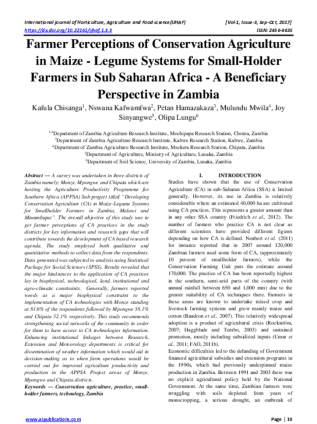
Farmer Perceptions of Conservation Agriculture in Maize - Legume Systems for Small-Holder Farmers in Sub Saharan Africa - A Beneficiary Perspective in Zambia

Type
File
Date of Publication
Sep 01, 2019
Description/Abstract

Abstract — A survey was undertaken in three districts of Zambia namely; Monze, Mpongwe and Chipata which are hosting the Agriculture Productivity Programme for Southern Africa (APPSA) Sub-project titled “Developing Conservation Agriculture (CA) in Maize-Legume Systems for Smallholder Farmers in Zambia, Malawi and Mozambique”. The overall objective of this study was to get farmer perceptions of CA practices in the study districts for key information and research gaps that will contribute towards the development of CA based research agenda. The study employed both qualitative and quantitative methods to collect data from the respondents. Data generated was subjected to analysis using Statistical Package for Social Sciences (SPSS). Results revealed that the major hindrances to the application of CA practices lay in biophysical, technological, land, institutional and agro-climatic constraints.  Generally, farmers reported weeds as a major biophysical constraint to the implementation of CA technologies with Monze standing at 81.6% of the respondents followed by Mpongwe 58.1% and Chipata 52.1% respectively. This study recommends strengthening social networks of the community in order for them to have access to CA technologies information. Enhancing institutional linkages between Research, Extension and Meteorology departments is critical for dissemination of weather information which would aid in decision-making as to when farm operations would be carried out for improved agriculture productivity and production in the APPSA Project areas of Monze, Mpongwe and Chipata districts. 

Author or Institution as Author
Kafula Chisanga
Co-authors

 Nswana Kafwamfwa, Petan Hamazakaza, Mulundu Mwila, Joy Sinyangwe, Olipa Lungu 
 

Institution
ZARI
Language
Category
Resource Type
Citation

Chisanga, K., Kafwamfwa, N., Hamazakaza, P., Mwila, M., Joy Sinyangwe, J., & Lungu, O. (2017). Farmer Perceptions of Conservation Agriculture in Maize - Legume Systems for Small-Holder Farmers in Sub Saharan Africa - A Beneficiary Perspective in Zambia. International journal of Horticulture, Agriculture and Food science(IJHAF) [online].Vol (1) (3), pp10-15. Available at:https://dx.doi.org/10.22161/ijhaf.1.3.3   


Principais características de 3 variedades de Amendoim libertadas em Moçambique

Type
File
Date of Publication
Sep 01, 2019
Description/Abstract

Neste panfleto, poderá encontrar três novas variedades de amendoim, lançadas recentemente em Moçambique pelo IIAM (Instituto de Investigação Agrária de Moçambique) no contexto de um projecto financiado pelo APPSA, liderado pelo Dr. Amade Muitia. No geral, essas variedades são tolerantes a secas, manchas precoces / tardias e roseta e produzem cerca de 2,5 toneladas por hectare. Os nomes das variedades são Mapupulo-018, Amena-018 e AMM-018.

Author or Institution as Author
Instituto de Investigação Agrária de Moçambique
Co-authors

Amade Muitia

Institution
IIAM
Language
Citation

Muitia,A (2019)Principais características de 3 variedades de Amendoim libertadas em Moçambique. Maputo, Mozambique

Main traits of 3 new Groundnut varieties released in Mozambique

Type
File
Date of Publication
Sep 01, 2019
Description/Abstract

In this flyer you will find 3 new groundnut varieties recently released in Mozambique by IIAM (Mozambique Agricultural Research Institute) under an APPSA funded project led by Dr. Amade Muitia. Overall, these varieties are tolerant to droughts, early/late leaf spots and rosette and yield around 2.5 tons per hectare. The names of the varieties are Mapupulo-018, Amena-018 and AMM-018.

Author or Institution as Author
Mozambique Agricultural Research Institute
Co-authors

CCARDESA

Institution
IIAM
Language
Citation

Muitia.A(2019) Main traits of 3 new Groundnut varieties released in Mozambique, Maputo, Mozambique.

Knowledge Product KP18 Decision Tool: Climate Smart Pest & Disease Management Option for Livestock

Type
File
Date of Publication
Aug 01, 2019
Description/Abstract

This Decision Tool aims to help field level extension staff make smart climate decisions on which pest and disease management options best suit their farmers’ context. This tool is not designed as a technical guide to implementation. It is designed to assist extension staff in making climate-smart decisions on improvements to their farming systems with their clients/farmers. Reference to technical guides relevant to the practices and technologies outlined are included at the end of the tool. The tool focuses on some of the Best Bet Climate-Smart Pest & Disease Management Options
for livestock production in the Southern African Development Community (SADC) region.

Author or Institution as Author
CCARDESA
Co-authors

CCARDESA/GIZ

Institution
CCARDESA
Language
Category
Resource Type
Citation

CCARDESA and GIZ (2019),  Knowledge Product 18: Climate Smart Pest & Disease Management Options for Livestock. Pg.20  CCARDESA Secretariat, Gaborone, Botswana.

Knowledge Product KP17 Decision Tool: Climate Smart Genetic Improvement Options for Livestock

Type
File
Date of Publication
Aug 01, 2019
Description/Abstract

This Decision Tool aims to help field-level extension staff make climate-smart decisions on which genetic improvement option best suits the context of their farmers. This tool is not designed as a technical guide to implementation. It is designed to assist extension staff in making climate smart decisions on improvements to farming systems with their clients. Reference to technical guides
relevant to the practices and technologies outlined are included at the end of the tool. The tool focuses on some of the Best Bet Climate-Smart Genetic Improvement Options for livestock production in the Southern African Development Community (SADC) region.

Author or Institution as Author
CCARDESA
Co-authors

CCARDESA/GIZ

Institution
CCARDESA
Language
Category
Resource Type
Citation

CCARDESA and GIZ (2019)  Knowledge Product 17 Climate-Smart Genetic Improvement Options for Livestock, Pg 14, CCARDESA Secretariat, Gaborone, Botswana.

Knowledge Product KP16 Decision Tool: Climate Smart Manure Management Options for Livestock

Type
File
Date of Publication
Aug 01, 2019
Description/Abstract

This Decision Tool aims to help field level extension staff make climate smart decisions on which manure management option best suits their farmers’ context. This tool is not designed as a technical guide to implementation. It is designed to assist extension staff in making climate smart decisions on improvements to their farming systems with their clients/farmers. Reference to technical guides relevant to the practices and technologies outlined are included at the end of the tool. The tool focuses on some of the Best Bet Climate-Smart Manure Management Options for livestock production in the Southern African Development Community (SADC) region.

Author or Institution as Author
CCARDESA
Co-authors

CCARDESA/ GIZ

Institution
CCARDESA
Language
Category
Resource Type
Citation

CCARDESA and GIZ (2019). Knowledge Product 16 Climate-Smart Manure Management Options for Improved Soil Fertility, pg. 18 CCARDESA Secretariat, Gaborone, Botswana.

Knowledge Product KP15 Climate Smart Pasture and Rangeland Management Options for Livestock in the SADC Region

Type
File
Date of Publication
Aug 01, 2019
Description/Abstract

This Decision Tool aims to help field level extension staff make climate-smart decisions on which pasture/rangeland management options best suit their farmers’ context. This
tool is not designed as a technical guide to implementation. It is designed to assist extension staff in making climate-smart decisions on improvements to their farming systems
with their clients/farmers. Reference to technical guides relevant to the practices and technologies outlined are included at the end of the tool. The tool focuses on some of
the Best Bet Climate-Smart Pasture and Rangeland Management Options for livestock production in the Southern African Development Community (SADC) region

Author or Institution as Author
CCARDESA
Co-authors

CCARDESA/GIZ

Institution
CCARDESA
Language
Category
Resource Type
Citation

CCARDESA and GIZ (2019) Knowledge Product 15: Climate Smart Pasture and Rangeland Management Options for Livestock in the SADC region. pg. 18 CCARDESA Secretariat, Gaborone, Botswana

Transforming Maize-Legume Systems for Climate Resilience A project implemented in Zambia, Malawi and Zimbabwe

Type
File
Date of Publication
Jun 01, 2019
Description/Abstract

This poster highlights the work that CCARDESA with the support from GIZ has done in Zambia, Malawi and Zimbabwe in implementing climate-smart agriculture practices which saw improved and increased yields in 19 pilot farms.

Author or Institution as Author
CCARDESA
Co-authors

CIMMTY 

Institution
CCARDESA
Language
Category
Resource Type
Citation

Mtunji.N (2019), Transforming Maize-Legume Systems for Climate Resilience A project implemented in Zambia, Malawi and Zimbabwe.pg.1. Gaborone, Botswana

Subscribe to Document

Funding Partners