BEAN PROCESSING ENHANCES FOOD SECURITY AND INCOME IN MOZAMBIQUE

Type
File
Date of Publication
Feb 01, 2017
Description/Abstract

Impact story

Author or Institution as Author
Agricultural Productivity Program for Southern Africa (APPSA)
Co-authors

Agricultural Productivity Program for Southern Africa (APPSA)

Institution
CCARDESA
Language
Category
Resource Type

AN ANALYSIS OF SORGHUM PRODUCTION TRENDS IN THE SEMI-ARID REGIONS OF ZIMBABWE.

Type
Date of Publication
Mar 01, 2019
Description/Abstract

¨Micronutrients are essential for plant growth and play an important role in balanced crop nutrition. They promote the strong ,steady growth of crops that produce higher yields and increase harvest quality- maximizing a plant’s genetic potential.

¨ Most micronutrients are immobile in soils and plants. There is therefore need to supply additional micronutrients to the soil.

Author or Institution as Author
Tafadzwa Cipangura
Institution
Department of Research and Specialist Services
Language
Citation

Sondayi,l.(2019),Effects of micronutrients on maize grain yield and macronutrients uptake
.2019.[Onlone]Harare:20

AN ANALYSIS OF SORGHUM PRODUCTION TRENDS IN THE SEMI-ARID REGIONS OF ZIMBABWE.

Type
Date of Publication
Mar 01, 2019
Description/Abstract

¨Micronutrients are essential for plant growth and play an important role in balanced crop nutrition. They promote the strong ,steady growth of crops that produce higher yields and increase harvest quality- maximizing a plant’s genetic potential.

¨ Most micronutrients are immobile in soils and plants. There is therefore need to supply additional micronutrients to the soil.

Author or Institution as Author
Tafadzwa Cipangura
Institution
Department of Research and Specialist Services
Language
Citation

Sondayi,l.(2019),Effects of micronutrients on maize grain yield and macronutrients uptake
.2019.[Onlone]Harare:20

CHARACTERISTICS OF WEEDS COMMONLY FOUND IN KATAMBORA RHODES GRASSES SEED PRODUCTION IN ZIMBABWE

Type
Date of Publication
Dec 01, 2018
Description/Abstract

—In Zimbabwe, KRG is grown in rotation with tobacco and irish potato to control the root knot nematode (Meloidogyne javanica). It is a good seed producer and the seed exported to mostly Arab countries that can hardly produce their own seed due to unfavourable climatic conditions.

Author or Institution as Author
Department of Research and Specialy Services
Institution
Ministy of Agriculture, Common Lands, Water, Climate and Rural Resettlement
Language
Citation

Zana, Monica M. (2018). CHARACTERISTICS OF WEEDS COMMONLY FOUND IN KATAMBORA  RHODES GRASSES SEED PRODUCTION IN ZIMBABWE. DR&SS. Harare, Zimbabwe.

CCARDESA Regional Information, Communication and Knowledge Management System

Type
File
Date of Publication
Nov 01, 2018
Description/Abstract

This brochure describes the new CCARDESA ICKM System.

Author or Institution as Author
CCARDESA
Institution
CCARDESA
Language
Resource Type
Citation

CCARDESA (2018). Regional Information, Communication and Knowledge Management (ICKM) System.

GIEC Rapport d’évaluation 5 (RE5): Les éléments scientifiques (Groupe de travail I) - Résumé à l’intention des décideurs

Type
Date of Publication
Jan 01, 2013
Description/Abstract

Dans cette contribution au cinquième Rapport d’évaluation du GIEC (RE5), le Groupe de travail I (GTI) examine de nouveaux éléments concernant le changement climatique sur la base de nombreuses analyses scientifiques indépendantes d’observations du système climatique, d’archives paléoclimatiques, d’études théoriques des processus climatiques et de simulations à l’aide de modèles climatiques. Il s’appuie sur sa contribution au quatrième Rapport d’évaluation du GIEC (RE4) et incorpore de nouveaux résultats de recherche obtenus depuis. Composante du cinquième cycle d’évaluation, le rapport spécial intitulé Gestion des risques de catastrophes et de phénomènes extrêmes pour les besoins de l’adaptation au changement climatique (SREX) représente un socle d’informations important sur l’évolution des extrêmes météorologiques et climatiques. Le présent Résumé à l’intention des décideurs suit la structure du rapport du Groupe de travail I. Ce texte s’accompagne d’une mise en exergue des principales conclusions qui, rassemblées, fournissent un résumé concis. L’introduction des principales sections se présente sous la forme d’un bref paragraphe en italique, qui souligne les bases méthodologiques de l’évaluation.

Author or Institution as Author
Thomas F. Stocker
Co-authors

Dahe Qin

Institution
Groupe d'experts intergouvernemental sur l'évolution du climat (GIEC)
Language
Category
Resource Type
Citation

GIEC, 2013: Résumé à l’intention des décideurs, Changements climatiques 2013: Les éléments scientifiques. Contribution du Groupe de travail I au cinquième Rapport d’évaluation du Groupe d’experts intergouvernemental sur l’évolution du climat [sous la direction de Stocker, T.F., D. Qin, G.-K. Plattner, M. Tignor, S. K. Allen, J. Boschung, A. Nauels, Y. Xia, V. Bex et P.M. Midgley]. Cambridge University Press, Cambridge, Royaume-Uni et New York (État de New York), États-Unis d’Amérique.

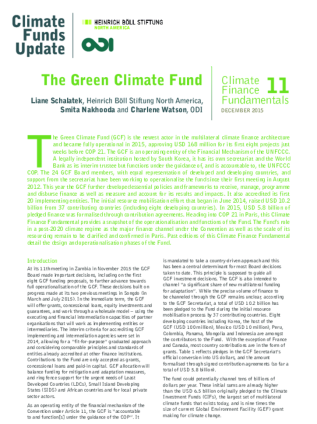
Climate Funds Update - The Green Climate Fund - Climate Finance Fundamentals

Type
File
Date of Publication
Dec 01, 2015
Description/Abstract

The Green Climate Fund (GCF) is the newest actor in the multilateral climate finance architecture and became fully operational in 2015, approving USD 168 million for its first eight projects just weeks before COP 21. The GCF is an operating entity of the Financial Mechanism of the UNFCCC. A legally independent institution hosted by South Korea, it has its own secretariat and the World Bank as its interim trustee but functions under the guidance of, and is accountable to, the UNFCCC COP. The 24 GCF Board members, with equal representation of developed and developing countries, and support from the secretariat have been working to operationalise the fund since their first meeting in August 2012. This year the GCF further developed essential policies and frameworks to receive, manage, programme and disburse finance as well as measure and account for its results and impacts. It also accredited its first 20 implementing entities. The initial resource mobilisation effort that began in June 2014, raised USD 10.2 billion from 37 contributing countries (including eight developing countries). In 2015, USD 5.8 billion of pledged finance was formalised through contribution agreements. Heading into COP 21 in Paris, this Climate Finance Fundamental provides a snapshot of the operationalisation and functions of the Fund. The Fund’s role in a post-2020 climate regime as the major finance channel under the Convention as well as the scale of its resourcing remain to be clarified and confirmed in Paris. Past editions of this Climate Finance Fundamental detail the design and operationalisation phases of the Fund.

Author or Institution as Author
Liane Schalatek
Co-authors

Smita Nakhooda, Charlene Watson

Institution
Heinrich Böll Stiftung North America
Language
Resource Type
Citation

Schalatek, L. and Nakhooda, S. and Watson, C. (2015). The Green Climate Fund - Climate Finance Fundamentals. Climate Funds Update. Heinrich Böll Stiftung North America and Overseas Development Institute, Washington DC and London

Green Climate Fund (GCF) - Concept note - User's guide

Type
File
Date of Publication
Jan 01, 2015
Description/Abstract

The objective of this user’s guide is to assist accredited entities to develop a concept note (CN) to be submitted to the Green Climate Fund ("Fund").

As a voluntary step, accredited entities may use the concept note to present a summary of a proposed project/programme to the Fund in order to receive feedback and recommendations from the Secretariat on whether the concept is broadly aligned with the Fund’s objectives. The recommendation will clarify whether the concept is endorsed, not endorsed with a possibility of resubmission, or rejected.

Author or Institution as Author
Green Climate Fund (GCF)
Institution
Green Climate Fund (GCF)
Language
Resource Type
Citation

Green Climate Fund (2015). Concept Note User's Guide.

Green Climate Fund (GCF) - Basic information

Type
File
Date of Publication
Dec 01, 2018
Description/Abstract

The Green Climate Fund (GCF) is a new global fund created to support the efforts of developing countries to respond to the challenge of climate change. GCF helps developing countries limit or reduce their greenhouse gas (GHG) emissions and adapt to climate change. It seeks to promote a paradigm shift to low-emission and climate-resilient development, taking into account the needs of nations that are particularly vulnerable to climate change impacts.

Author or Institution as Author
Green Climate Fund (GCF)
Institution
Green Climate Fund (GCF)
Language
Resource Type
Citation

Green Climate Fund (2018). Green Climate Fund (GCF) - Basic information.

Green Climate Fund (GCF) - Safeguards: Environmental and Social

Type
File
Date of Publication
Dec 01, 2018
Description/Abstract

International Climate Finance Funds require certain safeguards.

In carrying out its mandate of promoting a paradigm shift towards low-emission and climate-resilient development pathways in the context of sustainable development, GCF will effectively and equitably manage environmental and social risks and impacts, and improve outcomes of all GCF-financed activities.

Author or Institution as Author
Frank Udo Hoeggel
Institution
Green Climate Fund
Language
Resource Type
Citation

Hoeggel, F.U. (2018). Green Climate Fund (GCF) - Safeguards: Environmental and Social.

Subscribe to Document

Funding Partners