Evaluation of Cowpea (Vigna unguiculata L.walp) Genotypes for Biological Nitrogen Fixation in Maize-cowpea Crop Rotation

Type
File
Date of Publication
Nov 01, 2018
Description/Abstract

Nitrogen is a major plant nutrient which is most limiting in the soil due to soil losses of mineral nitrogen (N) form. To ensure availability of nitrogen in the soil, the study was conducted to screen four cowpea genotypes for Biological Nitrogen Fixation (BNF) and their contribution to maize yield in maize- cowpea rotation. The cowpea genotypes used were mutants LT11-3-3-12 (LT) and BB14-16-2-2 (BB) and their parental varieties Lutembwe (LTPRT) and Bubebe (BBPRT) respectively. Trials were established at two sites (Chisamba and Batoka) of different soil types. The Randomized Complete Block Design (RCBD) with three replications was used. Labelled 15N urea was applied at 20kgNha-1 on the four cowpea genotypes during 2015/16 growing season. Cowpea plant parts were dried and milled for 15N isotopic analysis. The data collected included Nitrogen content and atom % 15N excess in the fixing cowpea genotypes and non-nitrogen fixing pearl millet to determine total nitrogen derived from the atmosphere (TNdfa) and total nitrogen (TN) in plant parts which were further used to compute Biological Nitrogen Fixation (BNF). The results showed that BNF by cowpea genotypes at Chisamba was 63.9 kg ha-1 and was significantly (P<0.001) more than BNF of 6.6 kgha-1 at Batoka. The LT mutant fixed significantly (P<0.001) higher nitrogen of 86.1 kgha-1 and 16.5kg ha-1 at Chisamba and Batoka respectively than other genotypes. However, both BB and LT mutants significantly fixed more nitrogen than their parents and have demonstrated to increase maize grain yields up-to 12 tha-1 in the maize – cowpea rotation. 

Author or Institution as Author
Simunji Simunji
Co-authors

 Kalaluka L. Munyinda, Obed I. Lungu, Alice M. Mweetwa & Elijah Phiri 

Institution
Canadian Center of Science and Education
Language
Resource Type
Citation

Simunji, S., Munyinda, K., Lungu, O., Mweetwa, A., & Phiri, E. (2019). Evaluation of Cowpea (Vigna unguiculata L.walp) Genotypes for Biological Nitrogen Fixation in Maize-cowpea Crop Rotation. Sustainable Agriculture Research. [online]. Vol 8(1) pp 82-93. Available at https://doi.org/10.5539/sar.v8n1p82

Farmer Perceptions of Conservation Agriculture in Maize - Legume Systems for Small-Holder Farmers in Sub Saharan Africa - A Beneficiary Perspective in Zambia

Type
File
Date of Publication
Sep 01, 2019
Description/Abstract

Abstract — A survey was undertaken in three districts of Zambia namely; Monze, Mpongwe and Chipata which are hosting the Agriculture Productivity Programme for Southern Africa (APPSA) Sub-project titled “Developing Conservation Agriculture (CA) in Maize-Legume Systems for Smallholder Farmers in Zambia, Malawi and Mozambique”. The overall objective of this study was to get farmer perceptions of CA practices in the study districts for key information and research gaps that will contribute towards the development of CA based research agenda. The study employed both qualitative and quantitative methods to collect data from the respondents. Data generated was subjected to analysis using Statistical Package for Social Sciences (SPSS). Results revealed that the major hindrances to the application of CA practices lay in biophysical, technological, land, institutional and agro-climatic constraints.  Generally, farmers reported weeds as a major biophysical constraint to the implementation of CA technologies with Monze standing at 81.6% of the respondents followed by Mpongwe 58.1% and Chipata 52.1% respectively. This study recommends strengthening social networks of the community in order for them to have access to CA technologies information. Enhancing institutional linkages between Research, Extension and Meteorology departments is critical for dissemination of weather information which would aid in decision-making as to when farm operations would be carried out for improved agriculture productivity and production in the APPSA Project areas of Monze, Mpongwe and Chipata districts. 

Author or Institution as Author
Kafula Chisanga
Co-authors

 Nswana Kafwamfwa, Petan Hamazakaza, Mulundu Mwila, Joy Sinyangwe, Olipa Lungu 
 

Institution
ZARI
Language
Category
Resource Type
Citation

Chisanga, K., Kafwamfwa, N., Hamazakaza, P., Mwila, M., Joy Sinyangwe, J., & Lungu, O. (2017). Farmer Perceptions of Conservation Agriculture in Maize - Legume Systems for Small-Holder Farmers in Sub Saharan Africa - A Beneficiary Perspective in Zambia. International journal of Horticulture, Agriculture and Food science(IJHAF) [online].Vol (1) (3), pp10-15. Available at:https://dx.doi.org/10.22161/ijhaf.1.3.3   


Main traits of 3 new Groundnut varieties released in Mozambique

Type
File
Date of Publication
Sep 01, 2019
Description/Abstract

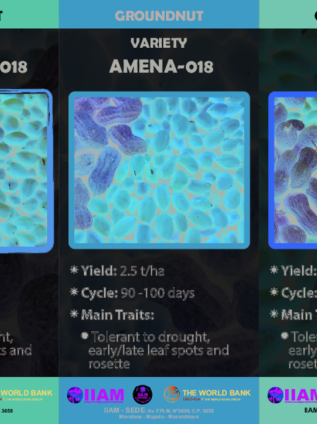
In this flyer you will find 3 new groundnut varieties recently released in Mozambique by IIAM (Mozambique Agricultural Research Institute) under an APPSA funded project led by Dr. Amade Muitia. Overall, these varieties are tolerant to droughts, early/late leaf spots and rosette and yield around 2.5 tons per hectare. The names of the varieties are Mapupulo-018, Amena-018 and AMM-018.

Author or Institution as Author
Mozambique Agricultural Research Institute
Co-authors

CCARDESA

Institution
IIAM
Language
Citation

Muitia.A(2019) Main traits of 3 new Groundnut varieties released in Mozambique, Maputo, Mozambique.

Sustainability assessment of farming systems in the Philippines with the RISE tool

Date of Publication
Sep 01, 2018
Description/Abstract

The Sector Project Sustainable Agriculture in cooperation with GIZ Philippines and the Agricultural Training Institute (ATI) conducted RISE analyses with the objective to compare different production systems in the Philippian provinces Leyte and Southern Leyte.

Author or Institution as Author
GIZ
Co-authors

Bern University of Applied Sciences School of Agricultural, Forest and Food Sciences HAFL Response-Inducing Sustainability Evaluation RISE

Institution
GIZ
Language
Category
Resource Type
Citation

Christian Thalmann,(2018) Sustainability assessment of farming systems in the Philippines with the RISE tool, pg30. Bern University of Applied Sciences, School of Agricultural, Forest and Food Sciences, Zollikofen: Switzerland

LESOTHO HOLDS A ONE DAY CAADP BIENNIAL REVIEW WORKSHOP

Date of Publication
Aug 01, 2019
Description/Abstract

The Ministry of Agriculture and Food Security (MAFS) in Lesotho held a one-day Comprehensive Africa Agriculture Development Programme (CAADP) Second Malabo Declaration Biennial Review (BR) Report Validation Workshop for all stakeholders in the agricultural sector. CAADP is Africa's Policy Framework for Agriculture and Agriculture-led development. It is aimed at reducing poverty and increasing food security in the continent through at least 10% public budget allocation to the sector in order to achieve at least 6% agriculture annual growth rate.
The Principal Secretary (PS) of MAFS, Mr. Malefetsane Nchaka officially opened the Workshop and thanked the participants for their attendance. He encouraged them to own the CAADP process as a sector and should not only be the responsibility of MAFS as the leading Ministry. He also acknowledged the presence of Regional Strategic Analysis and Knowledge Support System (ReSAKSS) at the validation workshop The PS mentioned that the first BR report was presented in January 2018 at the AU Ordinary Session, and Lesotho’s score was 3.7 out of 10 which did not reflect well on the country. The PS further encouraged the sector to do more in whatever may be required by asking the participants to provide with data as required so that when this current BR report is presented, Lesotho should have a better score than the 2018 score. 
  
The Lesotho CAADP Focal Person, Mr. Khesa presented the report on the results of the first Biennial Review where among the seven commitments, Lesotho scored an overall of only 3.7/10. Based on this score, the following were the recommendations that the country needs to consider in order to achieve a far better score in the next biennial review reporting. The recommendations were:
•    Lesotho should increase public agriculture expenditure as share of total public expenditure in line with the Malabo Declaration commitments, and stem the decline in the area of irrigated land.
•    The country should do more to integrate the youth and women in agricultural value chains.
•    The country should strengthen agriculture data collection and management systems (monitoring and evaluation) to ensure that missing under and unreported indicators are reported in the next round of the Biennial Review. Data was not available on the following areas: 
I.    Post-Harvest Loss;
II.    Farm Pastoral and Fisher Households that are resilient to climate change and weather related risks; and
III.    Participation of women in agriculture with access to finance.

The next Biennial workshop will be held in 2021. 
 

Author or Institution as Author
Rethabile Nchee
Institution
Department of Agricultural Research-Lesotho
Language
Category
Resource Type

Knowledge Product KP18 Decision Tool: Climate Smart Pest & Disease Management Option for Livestock

Type
File
Date of Publication
Aug 01, 2019
Description/Abstract

This Decision Tool aims to help field level extension staff make smart climate decisions on which pest and disease management options best suit their farmers’ context. This tool is not designed as a technical guide to implementation. It is designed to assist extension staff in making climate-smart decisions on improvements to their farming systems with their clients/farmers. Reference to technical guides relevant to the practices and technologies outlined are included at the end of the tool. The tool focuses on some of the Best Bet Climate-Smart Pest & Disease Management Options
for livestock production in the Southern African Development Community (SADC) region.

Author or Institution as Author
CCARDESA
Co-authors

CCARDESA/GIZ

Institution
CCARDESA
Language
Category
Resource Type
Citation

CCARDESA and GIZ (2019),  Knowledge Product 18: Climate Smart Pest & Disease Management Options for Livestock. Pg.20  CCARDESA Secretariat, Gaborone, Botswana.

Knowledge Product KP17 Decision Tool: Climate Smart Genetic Improvement Options for Livestock

Type
File
Date of Publication
Aug 01, 2019
Description/Abstract

This Decision Tool aims to help field-level extension staff make climate-smart decisions on which genetic improvement option best suits the context of their farmers. This tool is not designed as a technical guide to implementation. It is designed to assist extension staff in making climate smart decisions on improvements to farming systems with their clients. Reference to technical guides
relevant to the practices and technologies outlined are included at the end of the tool. The tool focuses on some of the Best Bet Climate-Smart Genetic Improvement Options for livestock production in the Southern African Development Community (SADC) region.

Author or Institution as Author
CCARDESA
Co-authors

CCARDESA/GIZ

Institution
CCARDESA
Language
Category
Resource Type
Citation

CCARDESA and GIZ (2019)  Knowledge Product 17 Climate-Smart Genetic Improvement Options for Livestock, Pg 14, CCARDESA Secretariat, Gaborone, Botswana.

Knowledge Product KP16 Decision Tool: Climate Smart Manure Management Options for Livestock

Type
File
Date of Publication
Aug 01, 2019
Description/Abstract

This Decision Tool aims to help field level extension staff make climate smart decisions on which manure management option best suits their farmers’ context. This tool is not designed as a technical guide to implementation. It is designed to assist extension staff in making climate smart decisions on improvements to their farming systems with their clients/farmers. Reference to technical guides relevant to the practices and technologies outlined are included at the end of the tool. The tool focuses on some of the Best Bet Climate-Smart Manure Management Options for livestock production in the Southern African Development Community (SADC) region.

Author or Institution as Author
CCARDESA
Co-authors

CCARDESA/ GIZ

Institution
CCARDESA
Language
Category
Resource Type
Citation

CCARDESA and GIZ (2019). Knowledge Product 16 Climate-Smart Manure Management Options for Improved Soil Fertility, pg. 18 CCARDESA Secretariat, Gaborone, Botswana.

Knowledge Product KP15 Climate Smart Pasture and Rangeland Management Options for Livestock in the SADC Region

Type
File
Date of Publication
Aug 01, 2019
Description/Abstract

This Decision Tool aims to help field level extension staff make climate-smart decisions on which pasture/rangeland management options best suit their farmers’ context. This
tool is not designed as a technical guide to implementation. It is designed to assist extension staff in making climate-smart decisions on improvements to their farming systems
with their clients/farmers. Reference to technical guides relevant to the practices and technologies outlined are included at the end of the tool. The tool focuses on some of
the Best Bet Climate-Smart Pasture and Rangeland Management Options for livestock production in the Southern African Development Community (SADC) region

Author or Institution as Author
CCARDESA
Co-authors

CCARDESA/GIZ

Institution
CCARDESA
Language
Category
Resource Type
Citation

CCARDESA and GIZ (2019) Knowledge Product 15: Climate Smart Pasture and Rangeland Management Options for Livestock in the SADC region. pg. 18 CCARDESA Secretariat, Gaborone, Botswana

Investigating the Type of Gene Action Conditioning Tolerance to Aluminum (Al) Toxicity in Tropical Maize

Date of Publication
May 01, 2009
Description/Abstract

Maize is a third important cereal crop in the world after wheat and rice. In Zambia, it is an important staple crop. Its production is however hampered by both biotic and abiotic factors. Among the abiotic factors, Aluminum (Al) toxicity causes high yield losses and is directly linked to acidic soils. Application of lime can ameliorate this problem, but it is expensive for small scale farmers.
Developing maize varieties that are tolerant to Al toxicity is cheaper and feasible for small scale farmers. The purpose of this research was to investigate the type of gene action conditioning tolerance to aluminum toxicity in tropical maize. Eleven inbred lines were mated in an 8 male (4 moderately tolerant and 4 susceptible) x 3 female (resistant) North Carolina Design II. Results revealed that general combining ability (GCA) effects due to both males and females were highly significant (P≤ 0.001) for root biomass. The shoot length GCA effects due to both male and female respectively were significant (P≤ 0.01). Similarly, the GCA effects due to females and males for root length were significant, P≤ 0.01 and P≤ 0.05 respectively. The genotype CML 511 had the most desirable significant GCA effect value (1.40) for root length among the male lines while CML 538 had the most desirable significant GCA effect value (0.92) among the female lines. The baker’s ratio for root length was found to be 0.49 implying that both additive and non-additive gene action were important in conditioning aluminum toxicity tolerance in tropical maize.

Author or Institution as Author
Victoria Ndeke
Co-authors

Langa Tembo

Language
Resource Type
Citation

Ndeke V., & Tembo L. Investigating the Type of Gene Action Conditioning Tolerance to Aluminum (Al)
Toxicity in Tropical Maize (2019). 2(4): 1-8, 2019

Subscribe to English

Funding Partners