African Agribusiness Incubators Network
AAIN is registered in Accra, Ghana as a private sector entity & internationally recognised as a Business Development Company.
African Agribusiness Incubators Network (AAIN), http://www.africaain.org.
AAIN is registered in Accra, Ghana as a private sector entity & internationally recognised as a Business Development Company.
African Agribusiness Incubators Network (AAIN), http://www.africaain.org.
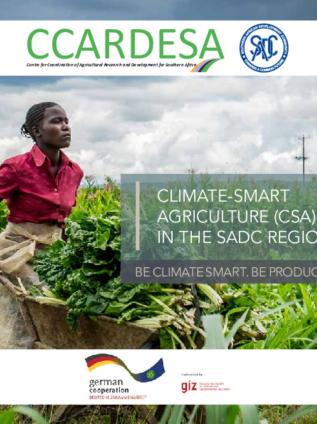
This presentation is CSA scoping study which was undertaken in order to establish the status of CSA understanding and implementation in SA at different levels and to establish the current CSA Policy framework in South Africa in terms of effectiveness and equity.
Pearson Mnkeni and Charles Mutengwa, (2016). FANRPAN, Climate Smart Agriculture (CSA) Scoping Study: Case Study of South Africa. p.31.
This presentation made during the tackling climate change in agriculture training in Zimbabwe, talks about climate change elements and interventions in the RAP.
CCARDESA, (2017). Climate Change Elements of the SADC Regional Agricultural Policy (RAP). p.13.
Maize is currently grown on 35 million hectares of land in Africa and is easily the most important staple food crop in the continent, feeding more than 200-300 million people and providing income security to millions of smallholder farmers. Nonetheless, African maize growers face many challenges, including lower than average yields, crop susceptibility to pests and diseases, and abiotic stresses such as droughts. They generally lack access to high yielding improved seed and other farming innovations that could help them overcome those challenges.
The Sustainable Intensification of Maize-Legume Systems for Food Security in Eastern and Southern Africa (SIMLESA) project, launched in 2010, supports farmers and partner organizations to achieve increased food production while minimizing pressure on the environment by using smallholder farmers’ resources more efficiently.
SIMLESA is led by the International Maize and Wheat Improvement Center (CIMMYT) and funded by the Australian Center for International Agricultural Research (ACIAR). It is implemented by national agricultural research systems, agribusinesses and farmers in partner countries: Ethiopia, Kenya, Malawi, Mozambique, Rwanda, Tanzania and Uganda.
A new video highlights the outcomes and achievements of the SIMLESA project and it features interviews with farmers and scientists.
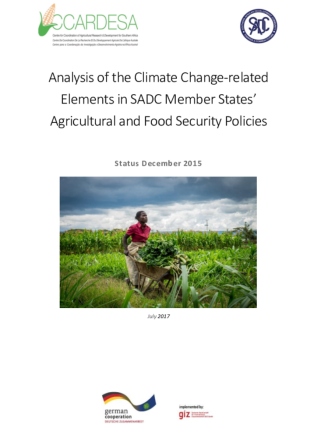
This report analyses the status of incorporation of climate change adaptation and climate-smart agriculture (CSA) measures in the SADC Member States’ agriculture and food security frameworks and policies. It details the current situation in the SADC member states with respect to the existence of policies, strategies and programmes that were primarily designed to build resilience to climate change among famers.
Miti, C. and Förch, W. and Mtunji, N. and Mwale, S. and Beerhalter, S. (2017). Analysis of the Climate Change-related Elements in SADC Member States’ Agricultural and Food Security Policies. ACCRA Policy Baseline Report.
Adapting to the negative impacts of climate change is a pressing challenge for anyone engaged in the agricultural sector. Smallholder farmers are particularly vulnerable to these changes such as erratic weather patterns, increased water shortages, shorter growing seasons, and changes in plant and animals diseases and agricultural pests. As a result of these challenges, water availability and soil quality decline. The knowledge and skills that help farmers protect themselves against these changes are imperative. The Clinton Development Initiative(CDI) works with 25,000 smallholder farmers in Malawi to apply Climate Smart Agriculture (CSA) adaptation and mitigation techniques on their farms. We sat down with Austin Ngwira, CDI’s Director of Agriculture, to learn more about how CSA is helping improve farmers’ food security with techniques that are more resilient to climate change. Read our Q&A with Austin below.
More than half of the 2.1 million people of Namibia live in the northern regions of the country. Furthermore, more than two thirds of the population depends on subsistence agriculture for their livelihood. Because Namibia's climate is already variable, and droughts are common, climate change is set to increase the already vulnerable community, of which most are women-led households.
Namibia, 2015. Review of Conservation Agriculture – Adaptation of Agriculture to Climate Change in Northern Namibia.
This booklet provides examples of climate-smart systems by showcasing some FAO success stories in various countries. The cases have been selected from the FAO Climate-Smart Agriculture (CSA) Sourcebook launched in 2013 to show the diversity of potential options across
different regions and agricultural systems also covering subjects such as biodiversity and gender.
Tanzania, 2013.FAO success stories on climate smart agriculture.
CCARDESA developed its 5-yearMedium Term Operational Plan (MTOP) in 2013, which was approved by the General Assembly in May 2014. The Development of the MTOP involved a number of stakeholders who were consulted and made input towards the content of the plan. The consultation process involved the National Agricultural Research and Extension Systems (NARES), development partners, international agricultural research centres, farmer organizations and others.
The MTOP outlined CCARDESA’s priorities and general approaches to programme implementation between 2014 and 2018. It also contained an elaborate list of activities under 5 thematic areas, expected outputs and a results framework. Within the results framework, indicators were identified, supported by specific annual cumulative targets during the 5 year period. This MTOP will end in December 2018.
The Operational Plan of an organisation is always anchored on the corporate strategic plan and is designed to translate the plan into actionable components within a given time frame. Unfortunately, the CCARDESA MTOP for the period 2014-2018 did not stem from a documented corporate strategy. This was a major weakness of the first five years of operation, notwithstanding the fact that the MTOP still gave a valuable basis for annual activity planning and guidance to the organisation between 2014 and 2018.
Since the current MTOP will expire in December 2018, CCARDESA is in need of a long term Strategic Plan which will provide a corporate definition of the visionary road that the institution should travel in the next 10 years. On the basis of the Strategic Plan, a concise and clear medium term operational plan shall be developed, to provide the implementation details of the Strategic Plan in the initial 5 years.
In order for CCARDESA to adequately serve its clients and deliver on its mandate, the Strategic Plan would need to respond to the needs of the SADC region in relation to the development and deployment of agricultural innovations and management practices. Along with this, the supportive environment such as gender, youth empowerment, sustainable use of natural resources, climate change and adaptation of agricultural practices within agricultural value chains to the envisaged changes, enabling policy frameworks and social/environmental responsibility have to be favourable and clear within the Strategic Plan. Furthermore, the Strategic Plan will need to be ‘forward looking’ by recognising the current situation in the SADC region and clearly showing that CCARDESA, through the implementation of the strategy, will be an indispensable relevant factor in contributing to the objectives set forth in the key policies of SADC Member States as well as the continental and global commitments they have signed for.
As a subsidiary organization of SADC, CCARDESA has to fulfil its role of contributing to the improvement of food security and livelihoods of the people, especially the small scale farmers and rural communities in general. Some of the key regional policy and strategic issues the CCARDESA Strategy will have to address are the regional needs expressed in the SADC Regional Agricultural Policy (SADC–RAP) and its investment plan, the revised Regional Indicative Strategic Development Plan (RISDP), the SADC Food and Nutrition Strategy (2015-2025), the SADC Industrialization Strategy and Road Map (2015-2063), the Climate Change Strategy and Action Plan (2015), and others.
At continental and global level, the Strategy will have to address the needs contained in the Comprehensive Africa Agriculture Development Programme (CAADP), together with the Malabo Declaration and the Sustainable Development Goals. In this regard, SDGs 1, 2 and 12 are the most critical to which CCARDESA is required to contribute directly.
CCARDESA therefore seeks the services of two consultants to develop its strategic and operational plans, both of which should be responsive to the needs of the region and set the organization on a trajectory that will bring impact to the food security and livelihoods of the communities in Southern Africa.
The overall objective of this assignment, therefore, is to develop a detailed 10-year CCARDESA Strategic Plan and a 5-year medium term operational plan, based on the needs of CCARDESA and its stakeholders.
The Centre for Coordination of Agricultural Research and Development for Southern Africa (CCARDESA) is a Subsidiary organisation of the Southern African Development Community (SADC). It was established in 2010 by Member States of SADC, and tasked with the mandate of coordinating agricultural research and development in the region. CCARDESA’s mandate is aligned to the Regional Indicative Strategic Development Plan, the SADC Regional Agricultural Policy and its investment plans, the CAADP/Malabo Declaration Commitment as well as the Sustainable Development Goals (SDGs). CCARDESA works closely with regional and international partners to facilitate generation and use of essential agricultural technologies and management practices. It also supports the exchange ofinformation and technology among Member states.
The operations of CCARDESA are guided by its strategy and an operational plan. The current Medium Term Operational Plan (MTOP), which provides details of the technical focus of the organisation for a period of 5 years, will elapse on 31stDecember 2018. The organisation therefore needs to develop a new Strategic Plan which will provide the priority boundaries of operation of CCARDESA for the next 10 years. The content and orientation of the CCARDESA strategy will be based on the available regional strategic priorities, current topical issues and envisaged trends of interest to the agricultural sector. The Strategy will be accompanied by an MTOP, which will articulate the operational details for the next 5 years. The MTOP is therefore the action guiding tool for achieving the objectives and targets of the Strategy.
CCARDESA is therefore inviting applications from qualified and experienced individuals to carry out the task of developing its 10 year Strategy and a Medium Term Operational Plan for 5 years. This is one assignmet but requires the services of two experts. Therefore it is applicants are required to submit their bid as a pair of two experts with profiles indicated in the Terms of Reference.
Details of the assignment are contained in the attached TORs.