APPROACHES IN BREEDING FOR HIGH QUALITY PROTEIN MAIZE

Type
File
Description/Abstract

Maize is the principal crop and major staple food in the most African and South American countries. The main problem in human nutrition in developing countries, and in livestock feed in developed countries, is insufficient production and poor quality of cereal proteins. In the case of maize, due to the very low content of essential amino acids lysine and tryptophan in grain endosperm, biological value is very low, which is main limiting factor of common maize in human nutrition and feeding of monogastric animals. Quality protein maize (QPM) can help in solving of this problem. Maize production also faces serious constraints caused by agro-ecological conditions and poor socio-economic situation. To alleviate the effect of the constraints, selected genotypes with more desirable traits and appropriate field-plot techniques to create multiple-stress conditions, were used. It was found that, in downy mildew nursery distance up to 35 m from spreader plot is providing sufficient down load of spores for plant infection, provided that the testing breeding materials are planted towards to down-stream direction of the dominant wind. Using these breeding approaches large number of early, white and flint synthetics, composites and inbred lines were created with resistance or tolerance to downy mildew (DMR), maize streak virus (SR) and drought (DT). Created genotypes exhibited very good kernel modification and yield potential under low and normal inputs. In the case of synthetics and composites, besides tolerance to multiple stress factors, they were competing in yield with local QPM and normal maize checks. In the case of created inbred lines high combining ability was exhibited both in non-conventional and conventional maize hybrids. Trial data revealed that in the most cases the best entries were over-yielding the best checks.

Author or Institution as Author
DENIC, M.
Co-authors

CHAQUE, P., FATO, P., SENETE, C., MARIOTE, D. and HAAG, W.

Language
Category

Selection of maize progenies for tryptophan content and grain yield

Type
File
Date of Publication
Feb 01, 2016
Description/Abstract

The incrementation of lysine, tryptophan and maize protein nutritional value in locals where maize is staple food could contribute significantly to improving the population nutritional status. The objective of this study was to estimate variance and average components related to the maize protein quality based on tryptophan and grain yield analysis, and to select from the early generations progenies which best complement with the tester for both characters. The laboratory analyses were carried out by using colorimetric reactions and the statistical analyses were based on mixed model. The experiment was set out in partially balanced square lattice with 144 treatments, two replications and 12 blocks. The estimations, associated with the assessed treatment performances made it possible to infer that both populations are promising for recurrent selection and suggested good experimental precision. The selective accuracy demonstrated the possibility of obtaining gains by selecting in both characters. For tryptophan content, the specific combining ability presented small magnitude value due the qualitative inheritance and, the additive effects might have been more important. The shrinkage effect in grain yield was more noticeable than the tryptophan content. Over 25% of the progenies contributed positively to the tryptophan content and only 3.65% to grain yield.

Author or Institution as Author
Senete, C.T.
Co-authors

 Fato, P., Massitela, J., Tamele, O.H. and de Souza, J.C.

Language

APPSA-Lesotho engages a consultancy firm to develop a Management Information System (MIS)

Type
File
Date of Publication
Nov 01, 2022
Description/Abstract

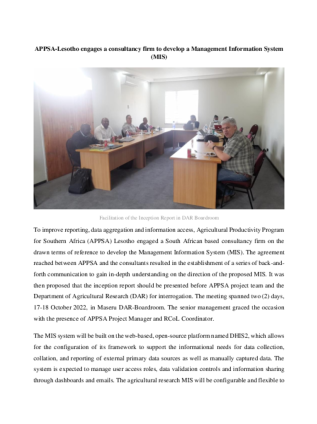
APPSA Lesotho engaged a South African based consultancy firm on the drawn terms of reference to develop the Management Information System (MIS). The agreement reached between APPSA and the consultants resulted in the establishment of a series of back-and-forth communication to gain in-depth understanding on the direction of the proposed MIS

Author or Institution as Author
Department of Agriculture
Language
Category

APPSA LESOTHO LAUNCHES COMPENDIUM OF STORIES

Type
File
Date of Publication
Nov 01, 2022
Description/Abstract

The compendium is a compilation of stories about project activities (research and development, agricultural extension, trainings, project management and monitoring) implemented under APPSA Lesotho. It is the mandate of the Communication Working Group (CWG) to manage project communication and technology dissemination for visibility and awareness, knowledge sharing and collaboration among stakeholders. The roles of Technology Dissemination Office; and Information Technology and Knowledge Management are responsible for ensuring the functionality and delivery of the objectives of the CWG.

Author or Institution as Author
Department of Agricultural Research
Language
Category

Effect of plant density on seed cotton yield

Type
File
Date of Publication
Nov 01, 2022
Description/Abstract

Cotton (Gossypium hirsutum L.) is an important cash crop for small-scale farmers in Mozambique. The yield is dependent on various factors of plant management, and this can be affected by variations in plant density. In Mozambique the cotton crop is mainly growed in plant and row space arrangement corresponding to 50,000 plants per hectare, which is considered low resulting in low cotton yielding.The goal of this study, was to evaluate the effect of plant density in cotton yield, Gossypium hirsutum L. The experiment was conducted in Namialo village, in a randomized complete block design with four replications in a split-plot, where the main plot was distance between the plants within the rows (15, 20, 25, 30 cm) and distance between the rows (50, 75, 100 cm) as subplots randomized in each plot, making plant from 33000 to 133000 plants per hectare. Results of this experiment showed no significant interaction between the distance between the rows and plants on cotton yield, number of bolls per plant and plant height. In addition, as the distance between the plants increased, the number of bolls per plant also increased. This experiment empathize that the combination of 70 cm between the rows and 20 cm between the plants, with a total density of about 71400 plants per hectare resulted in a highest yield.

Author or Institution as Author
SYLLA, N.A.
Co-authors

MALEIA, M.P.; ABUDO, J.

Language
Category

Agricultural Zoning and Recommendation of Pigeon Pea Cultivars in Mozambique

Type
File
Date of Publication
Nov 01, 2022
Description/Abstract

Pigeon pea is one of the important legumes for export and domestic consumption in Mozambique. The objective was to evaluate the performance of the genotypes and to stratify environments for agricultural zoning and subsequent recommendation. The experiments were conducted in the northern region of Mozambique, to evaluate grain yield, in randomized blocks, with three replications and 20 long-maturing genotypes, in the 2016/2017 season in four environments. The results were obtained through the joint analysis and the complementarity of information from the biometric methodologies of Eberhart and Russell, Centroid and GGE-biplot aiming at better use of the significant GXE interaction. A mega-environment (Nampula and Namapa) was observed, of which Namapa district was the most discriminating and representative. The genotypes suggested for a recommendation as cultivars showed average performance. The ICEAP01490 genotype was of specific adaptability to favorable environments (Nametil and Namapa district) and high stability, is recommended for medium to high technology environments and the ICEAP01498 genotype was of specific adaptability to unfavorable environments (Nampula and Montepuez district), is recommended for low technology environments. The ICEAP01409 genotype can be indicated for a general recommendation. The ideal genotype with high mean, general adaptability and high stability was not observed, suggesting evaluations in more environments.

Author or Institution as Author
Pedro, C.
Co-authors

Donça, M.C.B., Somueque, S. I., Barbosa, I. P., de Souza, J. E., Dique, J. E. L., Gimo, S. T., and Cruz, C.D

Language
Category

The Government of Mozambique Launches the Nutrition Education Program

Type
File
Date of Publication
Oct 01, 2022
Description/Abstract

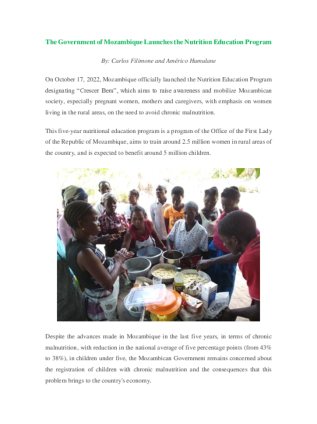
On October 17, 2022, Mozambique officially launched the Nutrition Education Program designating “Crescer Bem”, which aims to raise awareness and mobilize Mozambican society, especially pregnant women, mothers and caregivers, with emphasis on women living in the rural areas, on the need to avoid chronic malnutrition.

Author or Institution as Author
Carlos Filimone
Co-authors

Americo Humulane

Institution
INSTITUTO DE INVESTIGAÇÃO AGRÁRIA DE MOÇAMBIQUE (IIAM)
Category

Characterization of molecular features underlying drought tolerance in Mozambique´s drought tolerant maize (Zea mays L.) varieties

Type
Date of Publication
Oct 01, 2022
Description/Abstract

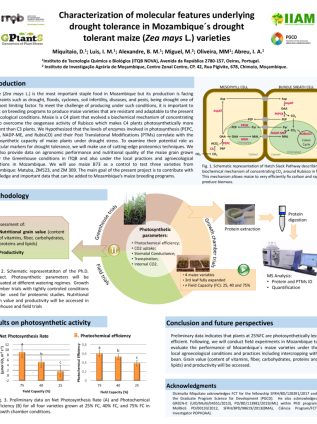
Maize (Zea mays L.) is the most important staple food in Mozambique but its production is facing constraints such as drought, floods, cyclones, soil infertility, diseases, and pests, being drought one of the most limiting factor. To meet the challenge of producing under such conditions, it is important to invest on breeding programs to produce maize varieties that are resistant and adaptable to the present agroecological conditions. Maize is a C4 plant that evolved a biochemical mechanism of concentrating CO2 to overcome the oxygenase activity of Rubisco, which makes C4 plants photosynthetically more efficient than C3 plants. We Hypothesized that the levels of enzymes involved in photosynthesis (PEPC, PPDK, NADP-ME, and RubisCO) and their Post Translational Modifications (PTMs) correlate with the photosynthetic capacity of maize plants under drought stress. To examine their potential role as molecular markers for drought tolerance, we will make use of cutting-edge proteomics techniques. We will also provide data on agronomic performance and nutritional quality of the maize grain grown under the Greenhouse conditions in ITQB and under the local practices and agroecological conditions in Mozambique. We will use maize B73 as a control to test three varieties from Mozambique: Matuba, ZM523, and ZM 309. The main goal of the present project is to contribute with knowledge and important data that can be added to Mozambique’s maize breeding programs.

Author or Institution as Author
Miquitaio, D
Co-authors

Luís, I. M.; Alexandre, B. M.; Miguel, M. ; Oliveira, MM ; Abreu, I. A.

Institution
INSTITUTO DE INVESTIGAÇÃO AGRÁRIA DE MOÇAMBIQUE (IIAM)
Language
Category
Citation

Miquitaio, D.; Luís, I. M.; Alexandre, B. M.; Miguel, M. ; Oliveira, MM ; Abreu, I. A. (n.d). Characterization of molecular features underlying drought tolerance in Mozambique´s drought tolerant maize (Zea mays L.) varieties

Influence of weaning management at 30, 75 and 180 days of age on non‐esterified fatty acids and reproductive performance in beef cows

Type
File
Date of Publication
Oct 01, 2022
Description/Abstract

This study aimed to investigate the effect of age at weaning of calves on non‐ esterified fatty acids (NEFA) and reproductive parameters of beef cows. Animals (n = 65) were randomly assigned to three treatments after calving: hyper‐early weaning (W30) at 32 ± 0.89 days, early weaning (W75) at 77 ± 0.95 days, and conventional weaning (W180) at 183 ± 0.82 days. Body weight (BW) and body condition score (BCS) were evaluated at parturition (AP) and at 30, 45, 64, 81, 100 and 115 days postpartum (dPP). Blood samples were collected to analyze NEFA levels and progesterone (P4) at 30, 45, 64 and 81 dPP. Higher BW and BCS were observed from 64 to 115 dPP in W30 cows than W180 ones (p < 0.05). Cows subjected to W30 condition had higher levels of NEFA at 30 dPP compared to 64 and 81 dPP (p < 0.05). We also observed that cows from W180 group showed decreased levels of NEFA at 30 dPP compared to 45 (p < 0.01) and 64 dPP (p < 0.05). The highest P4 level was observed at 64 dPP in W30 cows compared to W75 and W180 (p < 0.05). We also observed higher CR of W30 (86%) compared to W180 (47%) at 45 dPP (p < 0.05). The overall pregnancy rate (PR) was higher for W30 (95.5%) than W180 (73.9%). In addition, higher BW at calving and P4 levels at 30 dPP were positively correlated with the possibility of pregnancy (p < 0.05). Improvement in BW and BCS were observed in cows subjected to hyper‐early weaning management. However, levels of NEFA decreased as the postpartum period progressed. We concluded that cows who weaned calves hyper‐early have greater chances of increasing cyclicity and PRs.

Author or Institution as Author
Alforma, A. M. P
Co-authors

Pereira, G. R.; da Rocha, M. K. ;Teixeira, O.S.; Oliveira, M. C. M.; Lima, J.A.; Cumbe, T.A.; Barcellos, J.O.J

Language
Category
Citation

Alforma, A. M. P., Pereira, G. R., da Rocha, M. K., Teixeira, O. d. S., de Oliveira, M. C. M., Lima, J. A., Cumbe, T. A., & Barcellos, J. O. J. (2022). Influence of weaning management at 30, 75 and 180 days of age on non‐esterified fatty acids and reproductive performance in beef cows. Journal of Animal Physiology and Animal Nutrition, 1–11. https://doi.org/10.1111/jpn.13736

PARTNERING WITH FARMERS IN MOZAMBIQUE: DEVELOPING A FARMER RESEARCH NETWORK (FRN)

Type
File
Date of Publication
Oct 01, 2022
Description/Abstract

Agricultural scientists developed new bean varieties adapted to low soil fertility and extreme weather event including drought, which are the major factors limiting agricultural productivity in Mozambique. The new bean varieties are drought tolerant and phosphorus-efficient, have the potential to yield almost double that of local varieties, ie, between 1.5 to 3.0 ton/hectare, and represent different market classes and consumer preferences. Adoption of the new varieties is crucial for increasing production and productivity of common bean (Sevilla, 2013; Smith & Findeis, 2013). However, it is recognized that many farmers may not adopt the new varieties but continue to grow varieties not well adapted to current soil and climatic conditions. Low adoption may result from differences in variety performance in stressed environments that farmers face in their own fields as compared to what happens on station/demonstration plots. Similarly, the potential mismatch between farmer preferences and new variety traits, higher labor or other input requirements for new varieties coupled with the difficulty in accessing newly-released seed slows adoption. Recognizing that dynamic power relations, often defined by gender roles, influence men and women’s access to information and new technology adoption, this research examined how farmers evaluate and identify their preferred common bean traits.

Author or Institution as Author
Quinhentos, M.L
Co-authors

Camilo,S; Mubichi -Kut, F.; Findeis, J. 

Institution
INSTITUTO DE INVESTIGAÇÃO AGRÁRIA DE MOÇAMBIQUE (IIAM)
Language
Category
Citation

Quinhentos, M.L; Camilo, S; Mubichi-Kut, F; Findeis, J. Partnering with farmers in Mozambique: developing a farmer research network (FRN), (online). Mozambique

Subscribe to Partner Collections Content

Funding Partners