The continental AR4D Knowledge Management Agenda
This is a Key Note Presentation of the FARA Executive Director Dr Yemi Akinbamijo
Y. Akinbamijo(2021) Key Note Address- The Continental AR4D Knowldge management Agenda, Pgv15, Accra, Ghana
This is a Key Note Presentation of the FARA Executive Director Dr Yemi Akinbamijo
Y. Akinbamijo(2021) Key Note Address- The Continental AR4D Knowldge management Agenda, Pgv15, Accra, Ghana
This presentation highlights an overview of the CCARDESA Information, Knowledge and Data Capture Guidelines
B. Kakuwa (2021) An overview of the CCARDESA Information, Knowledge and Data Capture Guidelines, pg19, Gaborone, Botswana
This presentation highlights the CCARDESA Strategy Development
B.kakuwa (2021) CCARDESA ICKM Strategy Development, pg28, Gaborone, Botswana
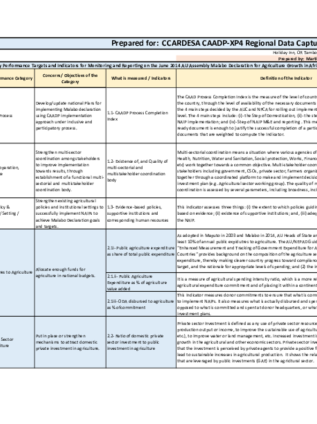
Malabo Declaration commitments performance Parameters and Measurements
This is an overview of the CAADP-XP4 Programme
F. Magagula(2021) Comprehensive for Africa Agricultural Development Programme Ex-Pillar 4 .Pg. 25, Gaborone. Botswana
Document for preparing country Biennial Review report on progress made for achieving the Malabo Declaration Goals and Targets
This is an overview of the alignment of the SDGs, Malabo and the Rap
M.Muchero, SDGs, Malabo & RAP aligment ,pg18, Gaborone, Botswana
This is an overview of the CAADP,MALABO & RAP linkages
M, Muchero (2021) CAADP,MALABO & RAP Linkages, pg. 26
Esta publicação foi elaborada no âmbito do Projecto de Apoio Técnico aos Programas de Nutrição e Segurança Alimentar de Moçambique (PSAL), inserida na cooperação técnica trilateral entre Moçambique, Brasil e Estados Unidos que teve como foco principal o fortalecimento da cadeia produtiva, o aumento da produção e a melhoria da qualidade das hortícolas produzidas em Moçambique, através da implantação de novas tecnologias de cultivo e de processamento visando o o incremento da oferta de alimentos e a diversificação da dieta alimentar das famílias. Este manual tem como finalidade de divulgar os principais resultados alcançados pelo Projecto PSAL, tendo como alvo todos os profissionais ligados à cadeia de valor das hortícolas em Moçambique.
Haber, L.L et al. (eds). (2015). Horticultura em Moçambique: características, tecnologias de produção e de pós-colheita. Brasília, DF: Embrapa.
Micronutrient deficiencies often occur as part of a cycle of malnutrition and may be coupled with protein energy malnutrition. One of the measure to fight malnutrition is through participatory dietary modification was used. Five recipes of banana-based porridges from two EAHB ‘nshakala’ and AAB ‘bira’ banana varieties and three maize-based porridges were formulated in combination with other ingredients. The contents of Iron and protein in separate ingredients and in modified recipes were analysed using flame atomic absorption spectrophotometry and Kjeldahl´s method, respectively, and bio-accessibility of iron was estimated using invitro simulating gastrointestinal digestion method. Beans were a good source of both iron and protein while groundnuts flour was a good source of protein. Contribution of iron and protein in recommended daily allowance (RDA) ranged from 75.3 to 458% and 106 to 146% in a portion of 500g respectively. Iron bioaccessibility in all recipes ranged from 7.4% to 31.1%. Iron in porridge recipes (6OFSP, 7B) was more bio-accessible. The developed and improved recipes showed great potential of contributing substantially to iron and protein needs of children 6-23 months. The importance of food diversification for intake of iron and protein is discussed.
Nkuba et.al (2017): Protein and iron contents and bio accessibility in local modified diets for children aged 6 to 23 months in Bukoba, Tanzania. African Journal of Food Science and Technology (ISSN: 2141-5455) Vol. 8(9) pp. 162-170, December, 2017 DOI: http:/dx.doi.org/10.14303/ajfst.2017.152 Available online @http://www.interesjournals.org/AJFST Copyright ©2017 International Research Journals