Padrão de Nota Conceptual para o APPSA
Nota Conceptual para o APPSA
Concept note template for APPSA
The Agronomy section and the Socio-Economics & Extension Division of the Department of Agricultural Research are collaboratively implementing the Lesotho Adaptation of Small-Scale Agricultural Production project (LASAP) activities with farmers in five districts of Lesotho.
Terms of reference
The Department of Agricultural Research through soils section is undertaking research studies on maize and beans varieties. The studies started in 2018 summer planting season. In order to fully involve farmers on these on-going studies, on-farm approach is used. The overall objective the studies is to evaluate two bean cultivars for biological nitrogen fixation and two maize cultivars for nitrogen use efficiency. This is done to restore the fertility of selected soils and crop productivity in an effort to help the farming community realize increased yields.
CCARDESA Annual Report 2020
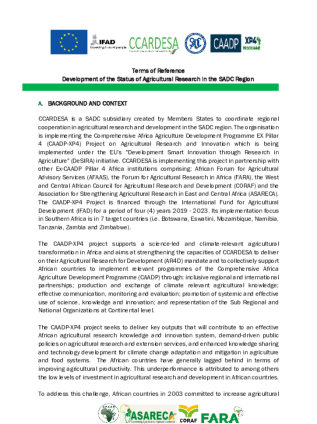
The main objective of the consultancy is to support the implementation of APPSA regional M&E activities. The specific objectives are to:
1. To Review and share Good Practice checklist for M&E and to foster the regional exchange of experience, good practices and tools through convening regular virtual meetings of the APPSA M&E Focal persons
2. To facilitate the establishment of M&E and Communication Working groups in Angola
3. To review the Results Frameworks for the 8 sub-projects that are currently being implemented
4. To Facilitate Results-based M&E training of RcoL staff
5. To develop guidelines on the establishment of database on agricultural technologies
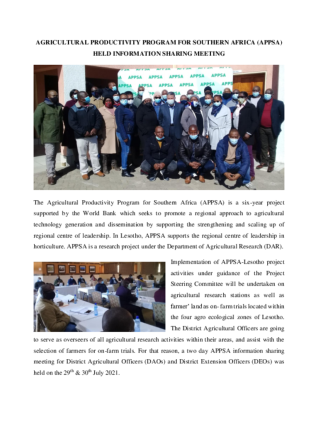
The Agricultural Productivity Programme for Southern Africa (APPSA)- is a project supported by the World Bank which seeks to promote a regional approach to agricultural technology generation and dissemination by supporting, strengthening and scaling up of regional centers of Regional Leadership on commodities of regional importance. APPSA is structured around four components of which one of them is technology generation and dissemination hence the reason for sub-projects that address this component.
Index-based insurance (IBI) compensates farmers in the event of a loss (Greatrex et al. 2015). IBI generally uses 'proxy' indices relating to specific risks (often climate-related) that may affect a farmer’s yield
CCARDESA 2019. Knowledge Product 24: Index-based insurance: How does it work and is it climate smart? CCARDESA Secretariat, Gaborone, Botswana.pg10
Farmers and other actors in agricultural value chains need significant amounts of information to implement Climate Smart Agriculture. Information and Communications Technologies (ICTs) and Digitalization can play a key role in knowledge exchange, targeting recommendations, market integration and access to finance.
CCARDESA 2019. Knowledge Product 23. Digital Agriculture: CCARDESA Secretariat, Gaborone, Botswana.pg10