Scaling up community resilience to climate variability and climate change in Northern Namibia, with special focus on women and children

Date of Publication
Oct 01, 2015
Description/Abstract

Namibia is one of the countries mostly vulnerable to the negative impacts of cli¬mate change which may affect our national development goals, particularly the agricultural sector, including food security. The Ministry of Environment and Tourism (MET) and the Ministry of Agricul¬ture, Water and Forestry (MAWF) is implementing a five-year project entitled “Scaling up community resilience to climate variability and climate change in Northern Namibia, with a special focus on women and children” (SCORE Project) with funding resources from the Global Environmental Facility (GEF) through the United Nations Development Programme (UNDP).

The SCORE Project is a five-year project with an overall GEF/SCCF allocation of USD3, 050,000.00 and co-finance from UNDP USD 860,000 and GRN USD 19,157,263.00. The project is being implemented in seven northern regions of Namibia namely: Oshana, Omusati, Ohangwena, Oshikoto, Kunene, Kavango West and Kavango East. These regions are regularly, and increasingly threatened by extreme weather events such as floods which causes damage to infrastructure and agricultural productivity, as well as severe droughts. A combined effect of these natural disasters have detrimental effect on the livelihoods of people including their health status.

The project aims to strengthen the adaptive capacity of 4000 households to climate change and reduce their vulnerability to droughts and floods, with 80% of these households being women-led, and children from 75 schools in Northern Namibia. The project’s desired outcomes include: (1) Smallholder adaptive capacity for climate resilient agricultural practices strengthened; (2) Reduce vulnerability to droughts and floods; and (3) Mainstreaming climate change into national agricultural strategy/sectoral policy, including budgetary adjustments for replication and scaling up.

Author or Institution as Author
Namibia_SCORE
Institution
Namibia
Language
Resource Type
Citation

Namibia_SCORE, 2015. Scaling up community resilience to climate variability and climate change in Northern Namibia, with special focus on women and children.

A Tool to Enhamce Conservation Tillage Practices in Namibia

Date of Publication
Dec 01, 2015
Description/Abstract

Local climate change and its variability pose greater risks for vulnerable, poor, and marginalized communities due to the physical impact it makes there. Since 2009, the UNDP-GEF CBA project in Namibia has been working with 12 villages that are facing a number of key problems that stemfrom extreme local climate events (e.g. pronounced droughts and floods, rising and variable temperatures, increasingly unpredictable rainfall patterns and amounts, severe land degradation leading to loss of productive arable land and range, loss of livestock, as well as high levels ofdeforestation and over utilization of natural resources).

The agricultural sector in Namibia is particularly affected by climate change. Droughts and erratic rains, interspersed with floods that originate in Angola, plague the northern side of the country and leave brittle, nutrient-poor soil, which renders farm lands unproductive. This negatively affects food, water security and general livelihoods due to failed harvests, and decreases livestock numbers and products. The UNDP-GEF CBA project is working to safeguard livelihoods by encouraging target communities to improve farm gate incomes, diversify the sources of other farm-based incomes, and properly utilize farmlands. The CBA project is also working with communities to build resilience and adaptive capacity to climate change in agro-pastoral communities and to foster community participation in the identification of climate drivers, risks and adaptive solutions. The target group is comprised of the most vulnerable community members, including women and children, that depend on rain-fed agriculture (e.g. planting pearl millet, maize, sorghum, ground nuts and cowpeas), natural resources (e.g. collecting fruit and oil from the wild), and livestock rearing for both subsistence and cash incomes in the semi-arid areas of northern Namibia. The first step, and short-term objective of the project, is to enlist community participation in the vulnerability assessment and solutions-generation stage by bringing members together to identify the climate change drivers, risks and adaptive solutions. The project uses a vulnerability reduction assessment method to assist communities, through a participatory process, in determining an appropriate plan of action. This is done through cohesive social groups and trainings before piloting projects.

Author or Institution as Author
UNDP Lesotho
Institution
Namibia
Language
Resource Type
Citation

 UNDP GEF. (2015). A Tool to Enhamce Conservation Tillage Practices in Namibia.

Traditional Zambian foods and their nutritional values

Date of Publication
Sep 01, 2016
Description/Abstract

Zambians should take pride and start consuming more indigenous vegetables and fruits to improve their nutrition status, a nutritionist has advised.

Nelly Phiri, the Nutrition Program Officer at the Zambia Civil Society Scaling up Nutrition Alliance said local vegetables such as Chibwabwa, Impwa and Kalembula have more nutrition value than most western foods.

Zambia is one of the most malnourished countries in the world with close to 40 percent of children under five years stunted while a growing adult population is obese.

Years ago, we never used to hear of malnutrition because we used to grow our own vegetables in the backyard.

Ms. Phiri said consuming local vegetables and fruits is cheaper and beneficial for households with low incomes.

‘Most of these vegetables and fruits contain vitamins like A,D, A, K which are fat soluble vitamins and B Complex which are water soluble vitamins and these can be gotten from our local fruits such as Baobab fruit which is locally known as Masau including the Masau which also have other mineral elements which people can benefit from,’ Ms Phiri said.

Institution
Zambia
Language
Resource Type
Citation

Traditional Zambian foods and their nutritional values. (2016)

Traditional vegetables in Zambia

Date of Publication
Jun 01, 2016
Description/Abstract

Traditional or local vegetables include many species which are wild, semi-cultivated or are protected in some way. They may also include species mainly cultivated for their pods, fruits, roots or tubers, but whose leaves are sometimes consumed as a vegetable. The majority of rural people in Zambia rely on traditional vegetables for their relish. In a rural survey, it was found that traditional vegetables were used by 52-95% of the respondents (Ogle et al. 1990). The diversity in traditional vegetables offers variety in family diet and helps ensure household food security. More than 175 different species have been documented as local vegetables in Zambia (Johansson 1989; Ogle et al. 1990). Among the more prominent species are Amaranthus spp., Cleome spp., Corchorus spp.,Disa satiria, Solanum aethiopicum/macrocarpon, Ipomoea spp., cassava, Zanthoxylum chalybeum, various cucurbits and Ceratotheca sesamoides. Apart from the major species, there are a large number of ‘minor’ vegetables known by fewer households and used less frequently. Many traditional vegetables are specific to particular areas and ethnic groups. Notes on the genetic resources, cultivation and use of some local vegetables are given below.

Author or Institution as Author
D.S. Mingochi
Co-authors

S.W.S. Luchen

Institution
Department of Agriculture
Language
Resource Type
Citation

D.S. Mingochi and S.W.S. Luchen, 2016. Traditional vegetables in Zambia.

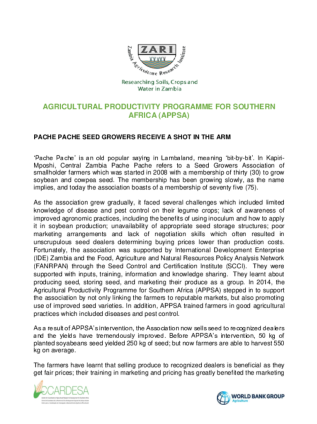
Pache pache seed growers receive a shot in the arm

Type
File
Date of Publication
Oct 01, 2017
Description/Abstract

Sucess Story of ‘Pache Pache’ - this is an old popular saying in Lambaland, meaning ‘bit-by-bit’. In Kapiri-Mposhi, Central Zambia, Pache Pache refers to a Seed Growers Association of smallholder farmers which was started in 2008 with a membership of thirty (30) to grow soybean and cowpea seed.

Author or Institution as Author
CCARDESA
Institution
CCARDESA
Language
Category
Resource Type
Citation

Phiri, N. 2017. Pache pache seed growers receive a shot in the arm, Zambia Seed Certification & Control Institute, Zambia

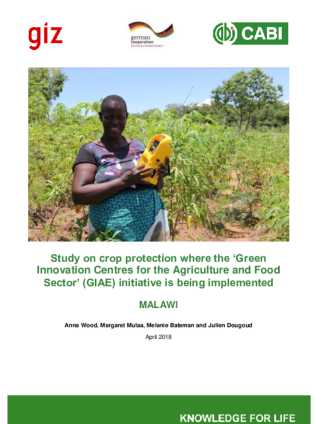
A Study on crop protection where the ‘Green Innovation Centres for the Agriculture and Food Sector’ (GIAE) initiative is being implemented in MALAWI

Type
File
Date of Publication
Apr 01, 2018
Description/Abstract

A review of pesticide regulations and a summary of registered pesticides. Key findings:

  • There are 158 registered active ingredients, incl. 49 HHP
  • In the groundnut and soybean value chain best practice approaches to pest managements are already being practiced
  • Increased pest monitoring, biopesiticides, improved and resistant varieties can support more effective pest management
  • Need for awareness-raising among farmers and advisers on pest identification
  • Policy-level support to incentivise the use of less toxic pesticides and increase availability and use of safer alternatives
Author or Institution as Author
Anna Wood
Co-authors

Margaret Mulaa, Melanie Bateman and Julien Dougoud

Institution
Deutsche Gesellschaft für internationale Zusammenarbeit (GIZ) GmbH
Language
Category
Resource Type

SADC Sucess Stories Vol. 2, 2017

Date of Publication
Aug 01, 2017
Description/Abstract

This is the 2nd volume of a collection of stories by SADC Secretariat to inform SADC citizens and enhance awareness about the positive impacts of SADC  protocols, agreements, policies and strategies.  It seeks to paint an accurate picture of how SADC regional integration programmes are changing the lives of SADC citizens for the better. Just to highlight a few, at the Zambezi River, there is the construction of the Kazungula Bridge that will soon form a major transport link in the heart of the SADC region. In Malawi, there is the Bvumbwe tomato, which was developed to address the specific conditions of this region and the needs of the SADC population.  And in Namibia’s Walvis Bay and Mozambique’s Nacala, there are two entry points to the growing network of development corridors alongside which the SADC region will develop in the coming decades.

Author or Institution as Author
SADC Secretariat
Institution
SADC
Language
Category
Resource Type
Citation

SADC Secretariat, 2017. SADC Sucess Stories Vol. 2, 2017, SADC Secretariat, Gaborone

The changing climate and human vulnerability in north-central Namibia

Date of Publication
Oct 01, 2016
Description/Abstract

North-central Namibia is more vulnerable to effects of climate change and variability. Combined effects of environmental degradation, social vulnerability to poverty and a changing climate will compromise subsistence farming in north-central Namibia (NCN). This will make subsistence and small-scale farmers in the region more vulnerable to projected changes in the climate system. Thus, the aim of this article was to examine factors contributing to subsistence farmers’ vulnerability to impacts of climate change. The article further discusses different aspects of human vulnerability and existing adaptation strategies in response to impacts of climate related disasters experienced over the past three to four decades in NCN. Qualitative and quantitative research approaches and methodology were employed to obtain information from subsistence farmers in north-central Namibia. The sociodemographic characteristics of Ohangwena, Oshana and Omusati Region reveals high levels of unemployment, high adult and elderly population and high dependency on agricultural livelihood system. These indicators help understand levels of household vulnerability. The study concludes that households interviewed revealed low levels of adaptive capacity due to exposure to climate risks and combined effects of social, political and cultural factors. This article provided an understanding that is required to inform the adaptation pathways relevant for NCN.

Author or Institution as Author
Margaret N. Angula
Co-authors

Maria B. Kaundjua

Language
Category
Resource Type
Citation

Angula, M.N. & Kaundjua, M.B., 2016, ‘The changing climate and human vulnerability in north-central Namibia’, Jàmbá: Journal of Disaster Risk Studies 8(2), Art. #200, 7 pages. http://dx.doi.org/10.4102/jamba. v8i2.200

Food losses - For sustainable resource use from field to fork

Date of Publication
Jun 01, 2016
Description/Abstract

This folder explores the issue of food loss in more detail and presents current experiences, challenges and areas of action.

Author or Institution as Author
German Federal Ministry for Economic Cooperation and Development (BMZ)
Co-authors

Bruno Schuler, Karl Moosmann, Maria Höhne, Tanja Pickardt Williams

Institution
German Federal Ministry for Economic Cooperation and Development (BMZ)
Language
Resource Type
Citation

Schuler, B. & Moosmann, K. & Höhne, M. & Pickardt Williams, T. 2016. Food losses - For sustainable resource use from field to fork, German Federal Ministry for Economic Cooperation and Development (BMZ), Division 122, Rural Development, Land Rights, Forests, BMZ, Berlin

Analysis of the Climate Change-related Elements in SADC Member States' Agricultural and Food Security Policies

Type
File
Date of Publication
Jul 01, 2017
Description/Abstract

This report analyses the status of incorporation of climate change adaptation and climate-smart agriculture (CSA) measures in the SADC Member States’ agriculture and food security frameworks and policies. It details the current situation in the SADC member states with respect to the existence of policies, strategies and programmes that were primarily designed to build resilience to climate change among famers.

Author or Institution as Author
CCARDESA
Institution
CCARDESA
Language
Category
Resource Type
Citation

CCARDESA. 2017. Analysis of the Climate Change-related Elements in SADC Member States' Agricultural and Food Security Policies, CCARDESA, Gaborone

Subscribe to English

Funding Partners