TORs for Regional Scoping Study to establish an inventory of existing training institutions for Natural Resource Management, Agriculture, Tourism and Climate Change in the SADC Member States
Terms of reference
Terms of reference
Budget allocation form
WAMPP is national in scope covering all of 10 Lesotho’s administrative districts, with a focus on the rangelands that cover more than two thirds of the country’s surface. The project pays special attention to poor rural women and young people with more emphasis on the foothills because there are more incidences of food insecurity.
Conservation Agriculture (CA) is currently widely recognized as a viable approach for sustainable agriculture due to its potentially comprehensive benefits of economic, environmental, and social sustainability. In response to the aforesaid, Tanzania Agriculture Research Institute (TARI) at Uyole Centre initiated intensive research on CA technology practices since 1999. The research started on-station and widened the geographical coverage of CA trials and promotions on-farm from two to 18 villages (Mkomwa et al., 2007) in Southern highlands of Tanzania. An onstation study was undertaken to evaluate influence of CA planting methods on labour, weed and maize yields. The study results show that use of tractor ripper, ox-direct seeder and ox-ripper had high yields of 8.5, 8.5 and 7.6 t/ha respectively compared to hand hoe (4.7 t/ha).
Mwakimbwala R1, Ngailo J1, Mlengera N1, Nyenza E2, Kabungo C 1, Mwalukasa E 2, Urio P 1, Kulwa B1 and Mwabenga (2018). Effect of Conservation Agriculture Planting Methods on Increasing Yield of
Maize: The Case of Southern Highlands Tanzania. 2ACCA Book of Condensed Papers - Final Draft 04.10.2018. https://africacacongress.org/generaldownloads/2acca-book-of-condensed-p…;
Agronomy research
Sondayi, L. (2019). Agromy Research
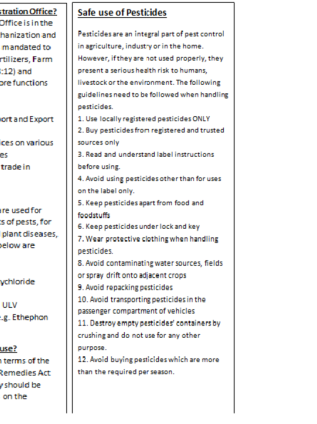
Pesticides registration in Zimbabwe
Sondayi, L. (2019). Pesticides registration
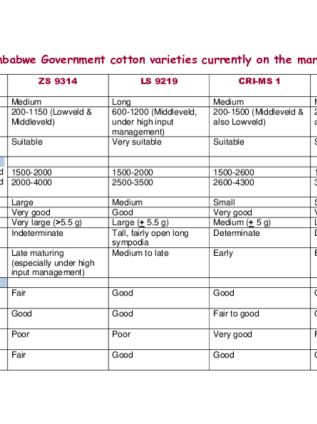
Cotton varieties in Zimbabwe.
Genetic Resources and Biotechnology
Sondayi. L.(2019). Genetic Resources and Biotechnology
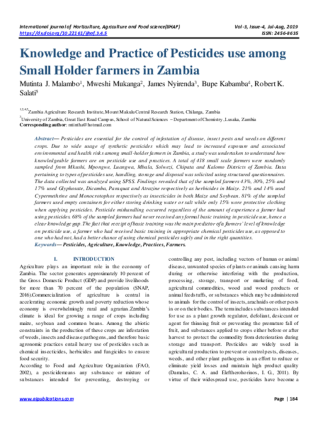
Pesticides are essential for the control of infestation of disease, insect pests and weeds on different crops. Due to wide usage of synthetic pesticides which may lead to increased exposure and associated environmental and health risks among small-holder farmers in Zambia, a study was undertaken to understand how knowledgeable farmers are on pesticide use and practices. A total of 418 small scale farmers were randomly sampled from Mkushi, Mpongwe, Luangwa, Mbala, Solwezi, Chipata and Kalomo Districts of Zambia. Data pertaining to types of pesticides use, handling, storage and disposal was solicited using structured questionnaires. The data collected was analyzed using SPSS. Findings revealed that of the sampled farmers 43%, 30%, 25% and 17% used Glyphosate, Dicamba, Paraquat and Atrazine respectively as herbicides in Maize. 21% and 14% used Cypermethrine and Monocrotophos respectively as insecticides in both Maize and Soybean. 81% of the sampled farmers used empty containers for either storing drinking water or salt while only 15% wore protective clothing when applying pesticides. Pesticide mishandling occurred regardless of the amount of experience a farmer had using pesticides. 68% of the sampled farmers had never received any formal basic training in pestic ide use, hence a clear knowledge gap. The fact that receipt of basic training was the main predictor of a farmers’ level of knowledge on pesticide use, a farmer who had received basic training in appropriate chemical pesticides use, as opposed to one who had not, had a better chance of using chemical pesticides safely and in the right quantities.
Malambo, M.J, Mukanga, M., Nyirenda, J., Kabamba, B., & Salati, K.R,. (2010). Knowledge and Practice of Pesticides use among Small Holder farmers in Zambia. International journal of Horticulture, Agriculture and Food science(IJHAF). pp184-190. Available at:https://dx.doi.org/10.22161/ijhaf.3.4.5 [05/09/2019]
Neste panfleto, poderá encontrar três novas variedades de amendoim, lançadas recentemente em Moçambique pelo IIAM (Instituto de Investigação Agrária de Moçambique) no contexto de um projecto financiado pelo APPSA, liderado pelo Dr. Amade Muitia. No geral, essas variedades são tolerantes a secas, manchas precoces / tardias e roseta e produzem cerca de 2,5 toneladas por hectare. Os nomes das variedades são Mapupulo-018, Amena-018 e AMM-018.
Muitia,A (2019)Principais características de 3 variedades de Amendoim libertadas em Moçambique. Maputo, Mozambique