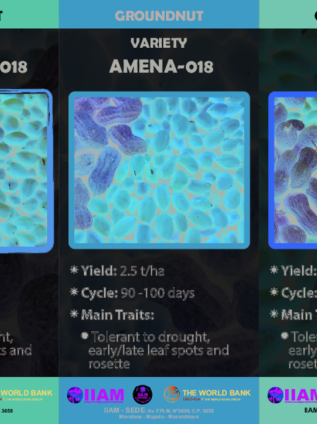
Main traits of 3 new Groundnut varieties released in Mozambique

Type
File
Date of Publication
Sep 01, 2019
Description/Abstract

In this flyer you will find 3 new groundnut varieties recently released in Mozambique by IIAM (Mozambique Agricultural Research Institute) under an APPSA funded project led by Dr. Amade Muitia. Overall, these varieties are tolerant to droughts, early/late leaf spots and rosette and yield around 2.5 tons per hectare. The names of the varieties are Mapupulo-018, Amena-018 and AMM-018.

Author or Institution as Author
Mozambique Agricultural Research Institute
Co-authors

CCARDESA

Institution
IIAM
Language
Citation

Muitia.A(2019) Main traits of 3 new Groundnut varieties released in Mozambique, Maputo, Mozambique.

Lesotho Stakeholder Consultation Workshop on Environmental and Social Safeguards Under the Agricultural Productivity Programme for Southern Africa(APPSA)

Type
File
Date of Publication
May 01, 2019
Description/Abstract

The Department of Agricultural Research (DAR) held a one-day workshop in Maseru, Lesotho 
on the Integrated Pest Management Plan (IPMP) and the Environmental and Social Monitoring 
Framework  (ESMF)  papers. These  documents  were  submitted  in  compliance  with  the 
Environmental Act of 2008 for application of  environmental clearance for DAR’s  research 
project under APPSA. The objective of the workshop was to validate  and review  these two 
documents.  

Author or Institution as Author
Department of Agricultural Research
Language
Category
Citation

Government of Lesotho. (2019). Lesotho Stakeholder Consultation Workshop on Environmental and Social Safeguards Under the Agricultural Productivity Programme for Southern Africa (APPSA). Maseru, Lesotho: Department of Agricultural Research.

AN ANALYSIS OF SORGHUM PRODUCTION TRENDS IN THE SEMI-ARID REGIONS OF ZIMBABWE.

Type
Date of Publication
Mar 01, 2019
Description/Abstract

¨Micronutrients are essential for plant growth and play an important role in balanced crop nutrition. They promote the strong ,steady growth of crops that produce higher yields and increase harvest quality- maximizing a plant’s genetic potential.

¨ Most micronutrients are immobile in soils and plants. There is therefore need to supply additional micronutrients to the soil.

Author or Institution as Author
Tafadzwa Cipangura
Institution
Department of Research and Specialist Services
Language
Citation

Sondayi,l.(2019),Effects of micronutrients on maize grain yield and macronutrients uptake
.2019.[Onlone]Harare:20

AN ANALYSIS OF SORGHUM PRODUCTION TRENDS IN THE SEMI-ARID REGIONS OF ZIMBABWE.

Type
Date of Publication
Mar 01, 2019
Description/Abstract

¨Micronutrients are essential for plant growth and play an important role in balanced crop nutrition. They promote the strong ,steady growth of crops that produce higher yields and increase harvest quality- maximizing a plant’s genetic potential.

¨ Most micronutrients are immobile in soils and plants. There is therefore need to supply additional micronutrients to the soil.

Author or Institution as Author
Tafadzwa Cipangura
Institution
Department of Research and Specialist Services
Language
Citation

Sondayi,l.(2019),Effects of micronutrients on maize grain yield and macronutrients uptake
.2019.[Onlone]Harare:20

CHARACTERISTICS OF WEEDS COMMONLY FOUND IN KATAMBORA RHODES GRASSES SEED PRODUCTION IN ZIMBABWE

Type
Date of Publication
Dec 01, 2018
Description/Abstract

—In Zimbabwe, KRG is grown in rotation with tobacco and irish potato to control the root knot nematode (Meloidogyne javanica). It is a good seed producer and the seed exported to mostly Arab countries that can hardly produce their own seed due to unfavourable climatic conditions.

Author or Institution as Author
Department of Research and Specialy Services
Institution
Ministy of Agriculture, Common Lands, Water, Climate and Rural Resettlement
Language
Citation

Zana, Monica M. (2018). CHARACTERISTICS OF WEEDS COMMONLY FOUND IN KATAMBORA  RHODES GRASSES SEED PRODUCTION IN ZIMBABWE. DR&SS. Harare, Zimbabwe.

Green Climate Fund (GCF) in brief: simplified approval process

Type
File
Date of Publication
Feb 01, 2018
Description/Abstract

The Green Climate Fund is moving quickly to build a large and transformative project portfolio, with many projects already being implemented with the objective to adapt and/or mitigate to climate change.

However, there is a need to simplify and streamline the approval of certain small scale projects, particularly from direct access entities. In response, the GCF’s Board has approved a new approach: the Simplified Approval Process Pilot Scheme (SAP), which is now operating.

The Board approved the first SAP project in February 2018 – an initiative by the Namibian direct access entity Environmental Investment Fund (EIF) to improve the ecosystem management practices of farmers.


Author or Institution as Author
Green Climate Fund
Institution
Green Climate Fund (GCF)
Language
Category
Citation

Green Climate Fund (2018). GCF in brief: simplified approval process.

Adaptation of agricultural practices to climate change in sub-Saharan Africa - Six categories of good practices in Africa

Type
File
Date of Publication
Dec 01, 2015
Description/Abstract

The purpose of this study was to undertake an empirical investigation of adaptation “good practices” and define six categories of actions that can be practically considered by governments for scaling-up in order to reduce the risks of climate change.

The focus is on what needs to be in place, in terms of the enabling environment, in order for the good practices to be effectively transferred to other contexts. The report thus intends to provide governments with practical options to consider in order to undertake agricultural adaptation to climate change, based on tangible and proven practices.

Six case study countries were chosen for empirical investigation of adaptation. Within Burkina Faso, Cameroon, Ethiopia, South Africa, Togo and Zambia, agricultural subsectors were chosen to represent various crops and livestock grown under different production systems. The purpose was to ensure that subsectors were investigated in more than one country so that there would be scope to compare different contexts. Categories considered for each adaptation practice were: proof of concept; robustness under projected climate change; environmental and social externalities; acceptability to farmers; accessibility to farmers; productivity; access to markets; support of appropriate institutions; level of government support; effects on women; and then a criteria to capture co-benefits, such as mitigation, biodiversity conservation, or multiple production objectives.

As a result the following six good practice categories are: use of improved seeds; soil fertility management; changing timing of farming practice; changing crop/livestock distribution and density; tillage and associated practices; and diversification.

Author or Institution as Author
Tennigkeit, T.
Co-authors

Vincent, K.

Institution
GIZ
Language
Category
Citation

Tennigkeit, T. and Vincent, K. (2015). Adaptation of agricultural practices to climate change in sub-Saharan Africa - Six categories of good practices in Africa. Gesellschaft für Internationale Zusammenarbeit, GIZ

Agriculture Urbaine à Antananarivo, un mécanisme d’adaptation au changement climatique

Date of Publication
Jan 01, 2016
Description/Abstract

L’Agriculture Urbaine est une réponse à plusieurs maux des grandes villes du Sud: les espaces limités, les déchets domestiques, l’urbanisation sauvage, les crues et inondations, la pollution, la précarité et la vulnérabilité face au changement climatique. Elle peut désormais changer la vie de milliers de Tananariviens, au-delà des nécessités de la survie quotidienne.
Renforcer l’identité originale de cette capitale dans sa tradition agricole est une contribution cruciale dans la lutte contre le changement climatique, tout en créant des conditions environnementales saines et respectueuses de la nature et des hommes.

Language
Category

The mineral composition of bambara groundnut (Vigna subterranea (L) Verdc) grown in Southern Africa

File
Date of Publication
Nov 01, 2006
Description/Abstract

The mineral content of nine landraces of bambara groundnut cultivated in Botswana, Namibia and Swaziland respectively was investigated. The raw seeds were analysed for Ca, K, Mg, Na, P, Cu, Fe and Zn. The ranges (mg/100 g dry matter) obtained for the macro minerals are: Ca 37-128, K 1545-2200, Mg 159-335, Na 16-25, P 313-563, and for the micro minerals (ppm): Cu 3.0-13.2, Fe 23.0-150 and Zn 13.9- 77.0. There were similarities and differences in the components determined in the landraces grown in a particular country and between the same landraces grown in different countries. This legume is a good source of, Ca, K, Mg, P and Fe. The Mg and P contents are similar to those of groundnut (Arachis hypogaea, P 376 and Mg 168). Landraces grown in Swaziland seem to have higher mineral contents than those grown in Botswana and Namibia. The concentration of the minerals in this legume indicates that they could be useful in the diets of consumers in Botswana, Swaziland and Namibia.

Author or Institution as Author
J.O Amarteifio
Co-authors

O. Tibe, R.M Njogu

Language
Category

Making the most of natural advantages: intellectual property and natural products in Botswana

File
Date of Publication
May 01, 2007
Description/Abstract

This report came about as a result of the desire of Botswana non-state actors to understand the issues surrounding the management of the intellectual property associated with their biodiversity, particularly natural products such as indigenous plants. The research work was conducted between 2-23rd May 2007 and consisted of key informant interview, preparation of case studies and reviews of laws, treaties and other literature. The purpose of this research was to work towards the development of an intellectual property regime for indigenous plants (and potentially other natural resources) in Botswana that promotes investment in the development of new products whilst protecting the in situ natural resource and ensuring full and equitable compensation for intellectual property. This was done through mapping the existing and needed intellectual property regime for indigenous plants. In the findings and recommendations, the consultants have been asked to state whether, in their opinion, the issue represents a „threat‟ (i.e., that some aspect such as biodiversity or livelihoods are „threatened‟) or an „opportunity‟ (i.e., that biodiversity or livelihoods could be positively impacted upon).

Author or Institution as Author
Ben Bennett
Co-authors

Yvonne Chilume

Language
Category
Citation

Ben Bennett & Yvonne Chilume, (2007). Making the most of natural advantages: intellectual property and natural products in Botswana.

Subscribe to Partner Collections Content

Funding Partners