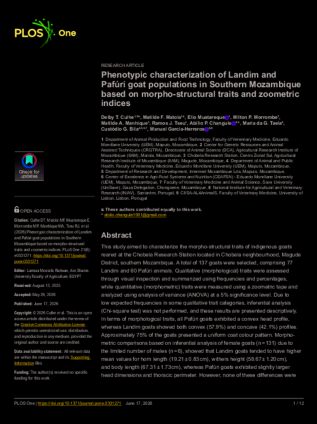
Phenotypic characterization of Landim and Pafúri goat populations in Southern Mozambique based on morpho-structural traits and zoometric indices

Type
File
Date of Publication
Jun 17, 2026
Description/Abstract

This study aimed to characterize the morpho-structural traits of indigenous goats reared at the Chobela Research Station located in Chobela neighbourhood, Magude District, southern Mozambique. A total of 137 goats were selected, comprising 77 Landim and 60 Pafúri animals. Qualitative (morphological) traits were assessed through visual inspection and summarized using frequencies and percentages, while quantitative (morphometric) traits were measured using a zoometric tape and analyzed using analysis of variance (ANOVA) at a 5% significance level. Due to low expected frequencies in some qualitative trait categories, inferential analysis (Chi-square test) was not performed, and these results are presented descriptively. In terms of morphological traits, all Pafúri goats exhibited a convex head profile, whereas Landim goats showed both convex (57.9%) and concave (42.1%) profiles. Approximately 75% of the goats presented a uniform coat colour pattern. Morphometric comparisons based on inferential analysis of female goats (n = 131) due to the limited number of males (n = 6), showed that Landim goats tended to have higher mean values for horn length (19.21 ± 0.83 cm), withers height (58.67 ± 1.20 cm), and body length (67.31 ± 1.73 cm), whereas Pafúri goats exhibited slightly larger head dimensions and thoracic perimeter. However, none of these differences were statistically significant (p > 0.05). Regarding zoometric indices, Landim goats tended to exhibit higher cephalic and thoracic indices, whereas Pafúri goats showed similar or slightly higher body, particularly among females. In contrast, Pafúri goats exhibited marginally higher proportionality indices, reflecting more elongated body proportions. Similarly, the small variations observed in zoometric indices did not reach statistical significance (p > 0.05). We hypothesized that, despite being reared under similar environmental conditions, Landim and Pafúri goat ecotypes would exhibit distinct morpho-structural characteristics due to differences in genetic background and adaptive history. These findings indicate that the morpho-structural differences between the two breeds are mainly descriptive rather than statistically supported. These results provide site-specific and preliminary baseline information for future genetic and phenotypic studies, thus may support conservation and sustainable utilization strategies for indigenous goat populations, particularly those reared under similar management and environmental conditions in southern Mozambique.

Author or Institution as Author
Culhe, D.T.
Co-authors

Matola, M.F., Muatareque, E., Morrombe, M.P., Manhique, M.A., Tseu, R.J., Changule, A.P., Maria da G. Taela, M., Bila, C.G., Garcia-Herreros, M.

Language
Topic
Category
Citation

 Culhe DT, Matola MF, Muatareque E, Morrombe MP, Manhique MA, Tseu RJ, et al. (2026) Phenotypic characterization of Landim and Pafúri goat populations in Southern Mozambique based on morpho-structural traits and zoometric indices. PLoS One 21(6): e0331271. https://doi.org/10.1371/journal.pone.0331271

H4H Communication and Visibility Plan

Type
File
Description/Abstract

The Centre for Coordination of Agricultural Research and Development for Southern Africa (CCARDESA) Herding for Health Knowledge Management (H4H KM) Project is aimed at contributing towards the improvement of livestock and rangeland management across the Southern African Development Community (SADC) region through documentation and dissemination of critical H4H information to a number of priority stakeholders who are making decisions and who directly involved in implementing livestock and rangeland management.

Institution
CCARDESA
Language
Topic
Category
Resource Type
Subscribe to Livestock

Funding Partners